
The short head bicep is the inner portion of the biceps brachii, the muscle that starts at your shoulder blade and runs down the inside of your upper arm. It bends the elbow and turns the palm up, and it responds best to curls where your arms stay in front of your body, such as preacher and spider curls. This guide covers where the muscle sits, how it differs from the long head, which exercises load it most, and how to program it week to week.
Where the Short Head Bicep Sits and How It Attaches
The biceps brachii has two heads, as the name says. The short head starts at the coracoid process, a small hook of bone on the front of the shoulder blade, and joins the long head partway down the upper arm. Both heads then share one tendon that attaches to the radial tuberosity, a bump on the radius bone of the forearm, according to the anatomy review in StatPearls from the National Library of Medicine.
The long head starts higher, at the supraglenoid tubercle inside the shoulder socket, and its tendon runs through a groove at the front of the upper arm bone. That route places the long head on the outer side of the arm and gives it much of the peak you see in a flexed pose. The short head sits on the inner side, which is the part visible when you hold your arm out with the palm up.
The musculocutaneous nerve supplies both heads. Their main jobs are elbow flexion and forearm supination, which is the motion of turning your palm up to hold a bowl of soup. The short head also helps pull the arm forward and toward the body at the shoulder, though that role is small.
Short Head vs Long Head: What Actually Differs
The difference between the two heads comes down to where they start, and that changes how they behave at the shoulder. The long head crosses the shoulder joint through the groove, so it stretches when your upper arm moves behind your torso. The short head crosses the shoulder only at the coracoid, so its length changes less when the shoulder moves and more when the elbow moves.
This is why exercise selection works the way it does. When your arm hangs behind you, as in an incline dumbbell curl, the long head starts in a stretched position. When your arm is out in front, as in a preacher curl, the long head is already slack, and the short head carries a larger share of the work relative to its partner.
Size is also different from person to person. Some lifters have a visibly fuller inner arm, and others have a higher peak, and a lot of that comes from muscle belly length and tendon insertion points you cannot change. Training can grow both heads, but it cannot rewrite your genetics.
Can You Really Isolate the Short Head?
You cannot isolate it completely, and anyone who says otherwise is overselling. Both heads cross the elbow, both attach to the same tendon, and both fire during almost every curl. Surface EMG studies, including work by Oliveira and colleagues in the Journal of Sports Science and Medicine (2009), show that shoulder position and grip change how active the biceps is, but the differences between heads are modest and vary from person to person.
What you can do is bias the load. I use a simple rule with clients: arms in front of the body shifts emphasis toward the short head, and arms behind the body shifts it toward the long head. It is a bias, not a switch, and the exercises below work because they apply that rule consistently.

This framing also saves you from a common trap. Lifters spend months chasing a “short head only” movement and neglect the basics, like adding weight or reps over time. The head you train matters less than whether the total biceps workload keeps rising.
Best Exercises for the Short Head Bicep
These four movements all keep the upper arm in front of the torso, which is the position that leans on the short head. Pick two or three per session rather than doing all of them at once.
1. Preacher Curl
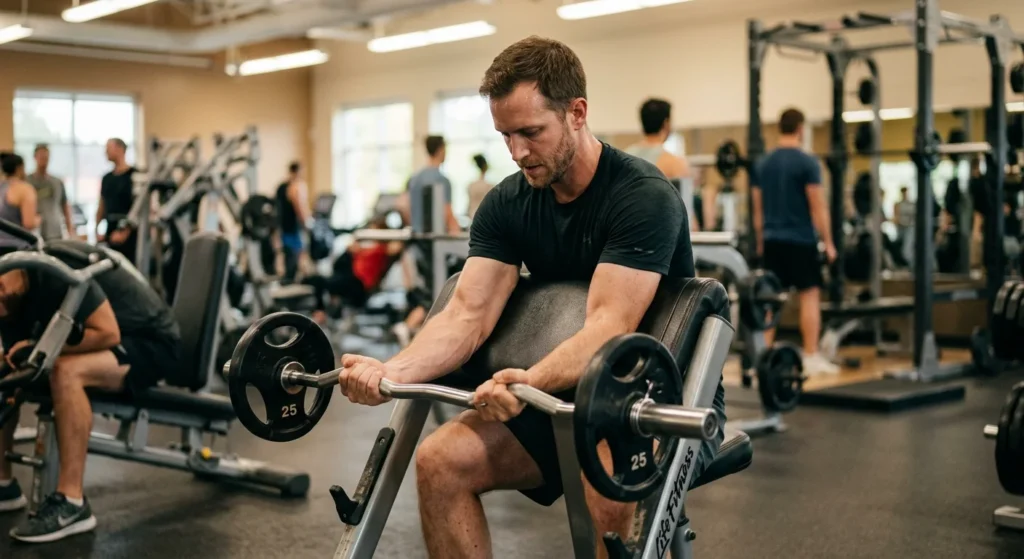
The preacher curl is the classic choice because the pad locks your upper arm forward and removes swinging. Sit with your armpits against the top of the pad, grip an EZ bar or dumbbells with palms up, and lower until your elbows are almost straight. Stop just short of locking out, since a fully relaxed bottom position puts a lot of stress on the biceps tendon.
Use a weight you can lift for 8 to 12 clean reps. If your wrists complain with a straight bar, the EZ bar or single dumbbells are easier to live with.
2. Spider Curl
Lie chest-down on an incline bench set to roughly 45 degrees, let your arms hang straight down, and curl with palms facing up. Gravity pulls straight down against the bar path, so the hardest point is near the top, where the muscle is fully shortened. Most lifters find they need about 20 to 30 percent less weight than on a standing curl.
Pause for a full second at the top of each rep. That pause is what makes this movement different from a regular curl.
3. Concentration Curl
Sit on the end of a bench, brace the back of your upper arm against your inner thigh, and curl a dumbbell with a palm-up grip. The braced arm sits slightly forward of the torso, and the setup makes cheating almost impossible. It is a good finisher when you want to chase fatigue without needing much weight.
Twist your pinky slightly toward the ceiling at the top, which adds a small supination bonus. Keep the movement slow on the way down, about three seconds.
4. Cable Curl With Arms in Front
Stand facing a low cable pulley, take a step back so the cable pulls your arms slightly forward, and curl with an underhand grip. You can also use two high cables and curl with arms out to the sides, the double-biceps pose position, which keeps tension on the muscle through the full range. The cable gives steady resistance at the bottom, where free weights feel light.
Keep your elbows fixed in front of your ribs rather than letting them drift back as you tire.

Grip Width and Hand Position: Separating Fact from Gym Lore
You will hear that a wide grip hits the short head and a narrow grip hits the long head. That claim has been repeated for decades, and the EMG evidence for it is thin. A wide grip on a straight bar tends to turn the wrists outward and can irritate them, so it is not free.
A more useful approach is to pick a grip that your wrists and elbows tolerate and keep the arm position in front of the body. Shoulder-width on an EZ bar is a safe default. If you want variety, rotate between bar, dumbbell, and cable work rather than hunting for a magic grip width.
Palm-up positions do matter in one way. The biceps is a strong supinator, so curling with the palm facing the ceiling lets it work through its full job. Hammer curls, with palms facing each other, shift more load to the brachialis and brachioradialis, which are useful but are not short-head exercises.
A Simple Weekly Plan for the Short Head Bicep
Volume is where most of the growth comes from. A 2017 meta-analysis by Schoenfeld, Ogborn, and Krieger in the Journal of Sports Sciences found that performing 10 or more weekly sets per muscle group was associated with greater hypertrophy than lower volumes. For the biceps, that means counting rows and pull-ups too, since they hit the muscle as well.
A workable starting layout for an intermediate lifter in the US training three to four days a week looks like this:
- Day 1: preacher curl, 3 sets of 8 to 12 reps, then concentration curl, 2 sets of 10 to 15 reps
- Day 2 or 3: spider curl, 3 sets of 10 to 12 reps with a pause at the top, then cable curl with arms forward, 2 sets of 12 to 15 reps
- Back days: rows and pull-ups as usual, which supply extra indirect biceps work
Rest at least 48 hours between direct biceps sessions, and stop sets one or two reps short of failure on most work. Add a rep or a small amount of weight each week, such as 2.5 pounds on dumbbells, rather than jumping up by 10.
Low reps, high reps, and everything in between can build muscle if the sets are hard enough. A 2015 meta-analysis by Schoenfeld and colleagues in the Journal of Strength and Conditioning Research found similar muscle growth from lighter and heavier loads when sets were taken close to failure. That gives you room to pick the rep range your joints like.
Common Mistakes That Stall Short Head Growth
The first mistake is swinging. If your torso rocks back at the bottom of each rep, the shoulders and lower back are doing work the biceps should be doing. Drop the weight until the upper arm stays still.
The second is cutting the range short. Many lifters curl only through the middle third of the motion because it is easy to lift heavy there. Lower the weight under control to near-full extension, and your results will usually improve even if the weight drops.
The third is ignoring the forearm. If your grip gives out before the biceps does, straps on your heaviest sets are a reasonable fix. Training the biceps to fatigue matters more than proving your grip strength on a curl day.
The last mistake is training the arms only once a week with a huge volume dump. Two moderate sessions usually beat one long one, because the muscle recovers between them and you can keep rep quality high.
Elbow Comfort and When to Get Help
Curls should feel like muscle work, not sharp pain at the front of the elbow or a pop near the shoulder. A distal biceps tendon tear is uncommon, but it happens with sudden heavy loading, and the American Academy of Orthopaedic Surgeons (AAOS) lists a pop or sudden pain at the elbow as a reason to be examined. A persistent ache in the groove at the front of the shoulder can point to an irritated long head tendon.

Warm up with a couple of light sets before heavy work, and avoid fully relaxing at the bottom of preacher curls under load. If pain lasts more than a few days or limits daily tasks, see a physician or physical therapist before continuing. This article is general fitness information and does not replace advice from a medical professional.