
What is muscular strength? It is the maximum force a muscle or muscle group can produce in a single effort, like lifting a weight you could only lift once. In daily life, it shows up when you shove a heavy box across a room or push a stuck car out of a snowbank.
This guide covers how muscular strength differs from endurance and power, how it is measured, why it matters for your health, and how to build it safely. Where sources disagree on details like rep ranges, I say so instead of quietly picking a side.
Muscular Strength Definition and Everyday Examples
Muscular strength is the ability to exert maximal force in one single contraction. That wording comes from an excerpt from the textbook Dancer Wellness by Mary Virginia Wilmerding and Donna Krasnow, published by Human Kinetics. Their example is a weight you could lift only once before needing a short break.
Study.com’s physical education lesson describes it as the ability to lift and move objects with maximum force for a short period. Healthline puts it as your ability to move and lift objects, measured by how much force you can exert. The phrasing differs, but the idea is the same. Strength is about the biggest effort you can produce, not how long you can keep going.
So a heavy deadlift counts and a long jog does not. It also explains why strength matters outside the gym. Lifting a suitcase into a car trunk or standing up from a low couch both draw on it.
Muscular Strength vs. Muscular Endurance vs. Muscular Power
These three terms get mixed up constantly, and the difference changes how you should train.
| Quality | What it means | Example |
| Muscular strength | Maximum force in one effort | One heavy squat |
| Muscular power | Large force produced quickly | A box jump |
| Muscular endurance | Lower force sustained or repeated | A long set of bodyweight squats |
Human Kinetics offers a useful shortcut: think of endurance as continuous and strength as maximal. Power sits between them, because it asks for high force and speed together.
Training follows the same split. Healthline and Study.com both say heavier loads for fewer reps build strength, while lighter loads for many reps build endurance. Study.com’s video lesson adds a caution: it is not quite that simple, since everyone responds a little differently.
One more mix-up is worth clearing up. Muscular endurance is not the same as cardiovascular endurance. A marathon tests your heart and lungs as much as your legs, while a long plank tests how long one muscle group can keep working.
How Muscular Strength Is Measured
The classic yardstick is the one-repetition maximum, or 1RM. It is the heaviest weight you can lift once with good form, and it matches the textbook definition exactly. For most people, testing a true max is unnecessary and risky without a spotter.
A safer option is tracking the heaviest weight you can move for a few clean reps. Study.com ties strength to loads you can lift only a handful of times, and many lifters record the weight they use for a hard set of five and watch it rise over several months.
Grip strength is the other measure worth knowing, because researchers use it as a quick stand-in for overall strength. A handheld dynamometer gives a reading in seconds. The PURE study, published in The Lancet in 2015, measured grip strength with a Jamar dynamometer in nearly 140,000 adults across 17 countries.

Bodyweight benchmarks work too. Push-ups and chair squats appear in the beginner routines Healthline describes, and you can track how many clean reps you manage over time. Write the number down after each session. A notes app works fine, and a month of entries shows more than memory does.
Whatever you pick to track muscular strength, test it the same way each time, with the same exercise, form, and rest period. Otherwise, the numbers will not tell you whether you actually got stronger.
Why Muscular Strength Matters for Your Health
The strongest evidence comes from grip strength research. In the PURE study, every 5 kg drop in grip strength was linked to a 16% higher risk of death from any cause, a 17% higher risk of cardiovascular death, a 7% higher risk of heart attack, and a 9% higher risk of stroke. The researchers adjusted for age, sex, height, and economic status. Grip strength also predicted all-cause and cardiovascular death better than systolic blood pressure did.
That is an association, not proof that weak hands cause early death. In an editorial published alongside the study, Avan Aihie Sayer and Thomas Kirkwood suggested grip strength may work as a biomarker of aging. Even so, it is a clear reason to keep your muscles working.
Healthline lists several everyday benefits, including better posture, less back pain, steadier balance, and a lower chance of falls. It also says strength training may improve mood, energy, and sleep, and that more muscle changes your body composition, meaning the ratio of fat to muscle.
The CDC’s guidance for adults is specific. Beyond 150 minutes of moderate aerobic activity each week, adults need muscle-strengthening activity on at least 2 days a week that works all major muscle groups: legs, hips, back, abdomen, chest, shoulders, and arms.
Most American adults fall short. WebMD’s coverage of CDC data from the 2020 National Health Interview Survey reports that only 24.2% of adults met both the aerobic and muscle-strengthening guidelines, and just 6.8% met the muscle-strengthening guideline alone. Another 46.3% met neither. The CDC noted that the data were self-reported and collected during the pandemic.
What Shapes Your Strength Level
Muscle size is part of the picture for muscular strength. Study.com notes that building strength increases the size of muscle fibers, which is one reason lifters gain muscle along the way.
Age, sex, and genetics also set different starting points, which is why comparing your numbers with a friend’s tells you little. Your own trend line is the useful comparison.
Time matters more than most beginners expect when they start building muscular strength. Human Kinetics says you may not notice results for 5 to 10 weeks, and that results do come. If you quit at week four, you quit right before the payoff.
Recovery is the other lever. Healthline recommends a day of rest between working the same muscle groups, and Human Kinetics suggests 60 to 90 seconds between sets. Human Kinetics also warns that tired muscles hand the work to other muscles, so form breaks down late in a set, which is when injuries tend to happen.
How to Build Muscular Strength
The basic recipe for building muscular strength has two parts. Use loads heavy enough that the last reps are hard, and increase the demand gradually over time.
1. Rep Ranges and Where Sources Disagree
Healthline suggests 2 to 3 sets of 8 to 12 reps for its strength exercises. Human Kinetics also recommends 8 to 12 reps through a full range of motion. Study.com mentions both 8 to 12 reps and 5 to 8 reps in different places.
My take is simple. Start with 8 to 12 reps using a weight that makes the final reps hard but still clean. Once your form is steady, moving toward 5 to 8 reps with heavier loads is reasonable.
2. Progressive Overload in Plain Terms
Human Kinetics defines progressive overload as gradually raising intensity, duration, and frequency. For beginners, it recommends a first stretch of about two weeks with lighter loads and 15 to 25 reps, then a shift to heavier weights and 8 to 12 reps.
A practical rule follows from that. When you finish every set at the top of your rep range with good form, add a small amount of weight next session. If form slips, hold the weight steady until it improves.
3. A Push, Pull, Legs, and Core Checklist
Most exercise lists give you moves but not a way to combine them. Here is a simple template: one lower-body movement, one pushing movement, one pulling movement, and one core movement per session.
Healthline’s list covers squats, biceps curls, modified push-ups, forearm planks, and crunches. Study.com adds lunges and pull-ups. Swap in whichever fit your equipment. Do the session on two non-consecutive days a week, which also meets the CDC’s minimum.
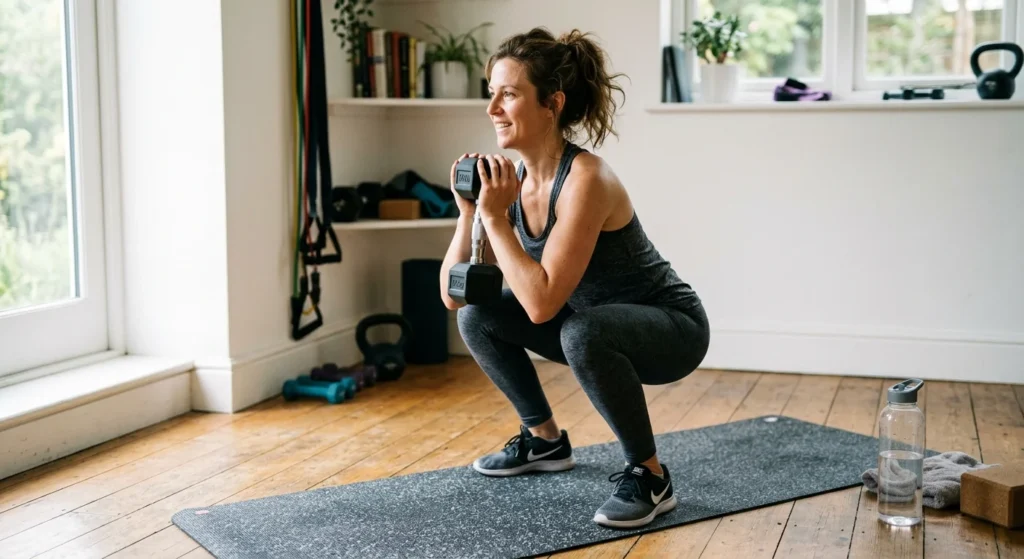
Healthline’s forearm plank guidance is up to one minute, repeated two to three times. Its squat tip is to sit back into a chair, which makes the movement easier while you learn it.

4. Training at Home Without Equipment
You do not need a gym. Study.com lists bodyweight exercises, resistance bands, and household items such as a bag of flour as workable options, and it notes that many parks have pull-up bars and similar equipment.
Push-ups scale well. Once 12 clean reps feel manageable, Study.com suggests raising your feet onto a small platform to increase the load on your arms and core.
5. Free Weights or Machines
Study.com’s video lesson says experts generally favor free weights for versatility and range of motion, while machines lower the chance of poor form because they guide the movement. A beginner can reasonably start on machines, then add free weights as technique improves.
Muscular Strength in Sports and Daily Movement
Athletes lean on muscular strength in different ways. Study.com points to wrestlers and boxers, who need force again and again with few breaks, and to sprinters and football players, who need maximum force in short bursts.
Human Kinetics makes a related point for dancers. Technique classes build some strength, but the authors say they should not be the only source, because a baseline of strength, power, and endurance lowers the risk of injuries tied to muscle imbalances. They also say adequate strength can improve joint stability and bone health.
The same logic applies to anyone who sits most of the day and then lifts a moving box on Saturday. A modest strength base means the sudden effort lands on muscles that have practiced it.
Safety Basics Before You Start
This article is general information, not medical advice. Study.com recommends talking with a doctor before starting any new routine, since a routine physical can catch problems such as an undiagnosed heart defect. Healthline gives the same advice to anyone new to exercise or dealing with injuries.
Healthline also recommends building up slowly over a few weeks, stopping if you feel pain, and using steady, controlled movements. Exhale as you lift and inhale as you lower, since holding your breath can raise blood pressure.

For heavy barbell work like the bench press, Study.com advises using a spotter. If you are unsure about technique, a personal trainer or physical therapist can check your form in a session or two.
Common Mix-Ups About Muscular Strength
Cardio does not replace strength work. The CDC lists aerobic activity and muscle-strengthening activity as separate weekly requirements, and the survey numbers above show many adults do one without the other.
Bigger muscles do not automatically mean more muscular strength. Size and strength are related, since strength training enlarges muscle fibers, but the number that matters day to day is what you can lift. Track your lifts, not your reflection.
You also do not need to be an athlete. The CDC guidelines apply to all adults, and the examples in the sources, from pushing a car out of snow to carrying a heavy child, are ordinary tasks.
Pick two non-consecutive days this week, choose one move for each pattern in the checklist above, and write down the weight and reps you used.