
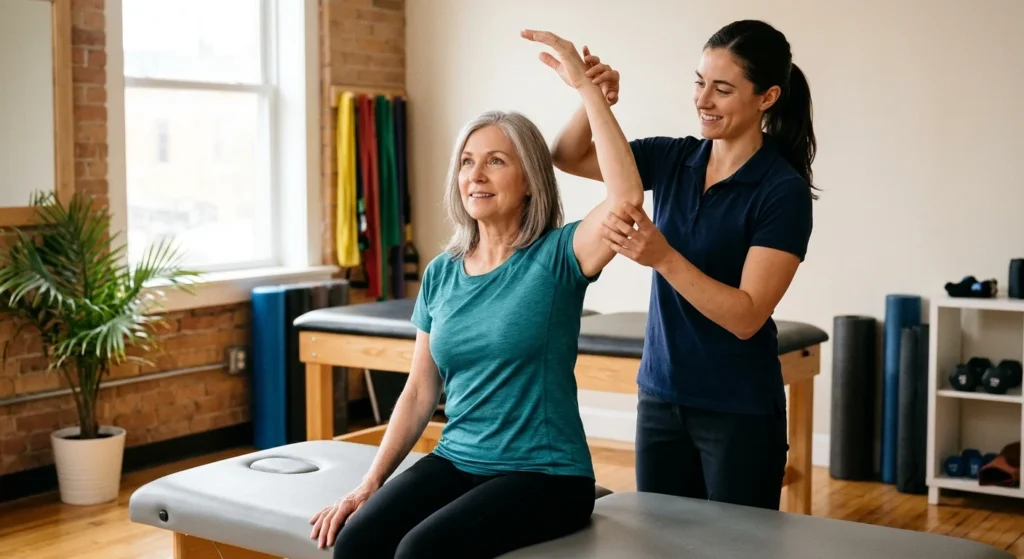

Muscle activation technique (MAT) is a hands-on assessment and treatment method that finds muscles not firing well, then stimulates them so the body can use them again. The core idea is that a tight muscle is often guarding a weaker one nearby. That view sets MAT apart from massage and stretching, which go straight at the tight spot.
This guide covers the theory, what happens in a session, who uses it, what it costs in the US, and what the evidence does and does not show.
Where Muscle Activation Technique Came From
Founder Greg Roskopf fell 20 feet in an Iowa rock quarry in 1982 as a college linebacker, which left him with a lower lumbar compression fracture. His back kept bothering him into his twenties. He spent about a decade developing a system for his own relief and put it together as MAT in 2000.
The company says the method requires certified training to apply safely. Roskopf says his programs train trainers and therapists across the country.
The best-known clients are athletes. Peyton Manning credited MAT in a 2012 Sports Illustrated piece for helping prolong his career. Golfer Bryson DeChambeau also first came to Roskopf for a nagging back problem.
The Theory Behind MAT: Tight Muscles as Protection
Why a Tight Muscle May Not Be the Real Problem
MAT’s core claim is that when the body senses instability, the brain sends a message to tighten the muscles around that area. Roskopf compares it to a loose battery cable in a car. The fix is the connection, and the part that is acting up is only reacting.
Rory Ford, a trainer certified in MAT, explained the logic to a Minneapolis TV station. He said a tight muscle is protecting a weak one somewhere else, so once the weak muscle works, range of motion becomes symmetrical on both sides.
The Walking-on-Ice Analogy
Roskopf often points to walking on ice, where your range of motion shrinks because your body is protecting itself. MAT aims to thaw that guarded state so muscles can contract through a full range again.
He also says that what a person cannot do is a clue to what is breaking them down. That is why assessment comes before any treatment.
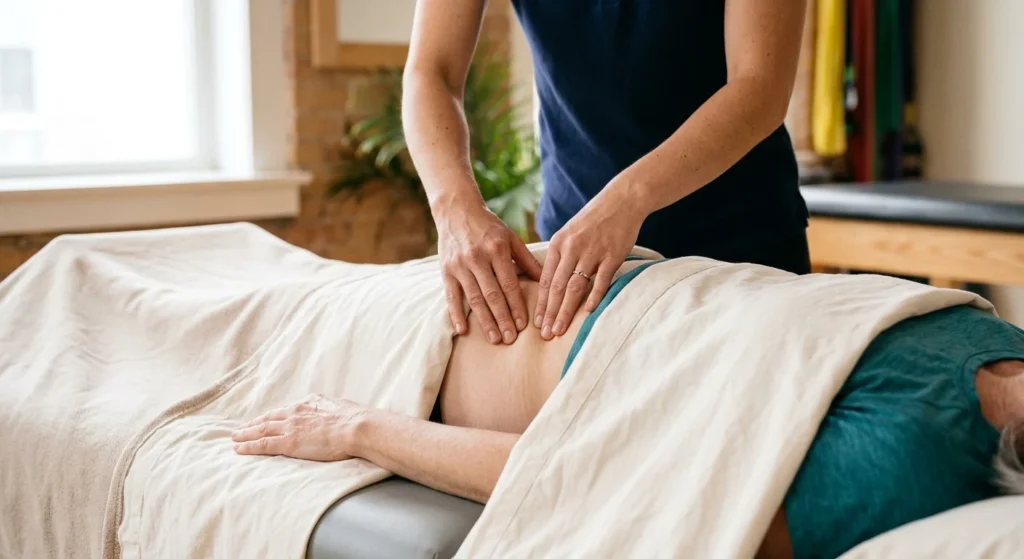
What Happens in a MAT Session
One MAT provider lays out a five-step loop:
- Assess range of motion to find where movement is limited.
- Test muscle strength with the Active Muscle Contract and Sustain Test.
- Correct the weakness that showed up.
- Retest the muscle’s strength.
- Reassess range of motion.
The correction step is manual. The practitioner applies targeted input at a muscle’s origin and insertion points, which MAT says helps reset communication between the muscle and the nervous system. A therapist profiled in Metropolis Japan described working the attachment site instead of massaging the muscle itself.
Exercise usually follows. With DeChambeau, Roskopf stimulated the weak muscles first, then had him do isolated strength work through full and shortened ranges of motion.

Session length varies. A full evaluation can take up to a few hours, according to the WCCO report. One health club lists one-hour sessions.
What to Wear and Bring
Wear shorts and a fitted top so the practitioner can see your joints move. Bring any imaging reports or notes from a physician or physical therapist, along with a short list of the movements that hurt or feel stuck.
Expect to be tested on both sides. The goal is to find asymmetries between your right and left sides.
Who Uses MAT and What They Bring to It
MAT’s education arm says the method has been used by NFL, NBA, MLB, PGA, and Olympic athletes, along with everyday people with chronic pain or mobility problems. That is the company describing itself, so read it as marketing.
Individual stories show the range. Roskopf found DeChambeau’s left side was weaker, which loaded his dominant right side in the golf swing and contributed to his back pain. A 54-year-old marathoner in a Chicago station’s report could not fully straighten her right knee, so she dragged that foot and tripped while running.
A client in a Japanese profile used MAT after a knee dislocation, and practitioners there also use it for posture and stiffness from everyday habits. A golf writer in an interview said he saw Roskopf for shoulder pain.
How MAT Compares With Massage, Stretching, and Physical Therapy
Massage tries to release a tight muscle. MAT therapist Kazutaka Ara says the tight muscle is doing its job as protection and that a different muscle is weak.
Stretching and strength work still have a place. MAT practitioners generally pair activation with exercise, as the DeChambeau program shows.
Physical therapy is a licensed profession, while MAT is a certification. MAT is used by trained professionals across the health, fitness, and wellness industries. Your experience depends a lot on the base training of the person treating you.
Insurance follows from that. A licensed physical therapist who uses MAT may be able to bill a visit as therapy, while a trainer in a gym usually charges a flat fee. Ask before booking.
Do not confuse MAT with muscle energy technique. Muscle energy technique is a separate manual method studied in chronic low back pain trials.
What the Evidence Shows
Most of what is written about MAT comes from the company’s education site, practitioner interviews, and media features about athletes. These describe results but are not controlled trials. Endorsements from pro athletes, including Manning, are testimonials.
Related methods have more published research. A systematic review of muscle energy technique lists small trials, with samples such as 30 and 40 patients. Searches of public sources turn up no comparable body of controlled MAT trials.
The “root cause” language is also the company’s framing. Muscles can weaken for several reasons, including nerve problems, so a clinician should rule out medical causes. Treat reported results as practitioner and client accounts, and judge MAT by how your own pain, strength, and range of motion respond over a few visits.
What Muscle Activation Technique Costs in the US
A Chicago TV report put a session at about $85 to $150. One health club lists member pricing of $90 for a one-hour session.
Price depends on the city, the practitioner’s credentials, and session length. MAT’s own materials say frequency is often important because sessions aim to build connectivity in weakened muscles. Ask how many visits to expect before you pay for a package.
How to Choose a Practitioner and Stay Safe
MAT’s education site has a practitioner directory. Check the listing, then ask about the person’s base license or certification and how long they have worked with MAT.
Good questions to ask: What will you test first, how will we know a muscle has improved, and when would you send me to a doctor? A practitioner should be able to explain the retest step in plain language.
Be cautious about promises of a cure, pressure to prepay for a large block of visits, or advice to skip a medical evaluation.

See a physician first for sharp or worsening pain, numbness, swelling, or weakness after an injury. This article is general information, not medical advice, and muscle activation techniques should not replace a diagnosis from a licensed clinician.