
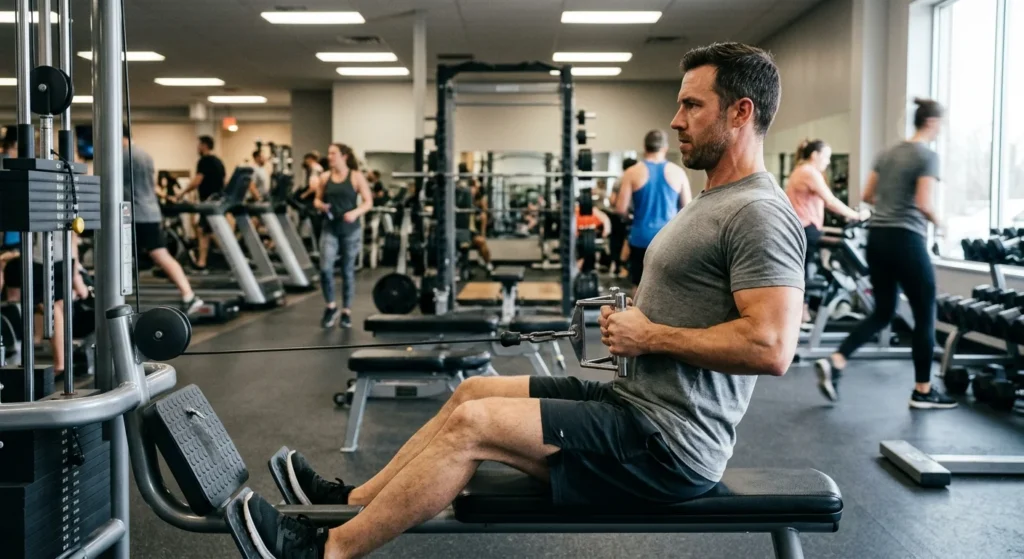

The best cable back exercises are the lat pulldown, seated cable row, single-arm cable row, straight-arm pulldown, and face pull. Between them, they work your lats, rhomboids, traps, and rear delts with steady tension from the first inch of a rep to the last.
You do not need a barbell or a pull-up bar to train your back well. One adjustable cable station can cover vertical pulls, horizontal rows, rear delt work, and even a hip hinge for your lower back. This guide covers nine moves, how to set the pulley for each, and a weekly plan you can start this week.
Check with a doctor before starting a new program, especially if you have back, neck, or shoulder pain.
Why Cables Work So Well for Back Training
Cables keep tension on the working muscle through most of the rep, because the pull comes from a pulley instead of gravity acting on a loose weight. A dumbbell row gets easier near the top. A cable row does not.
You can also change the angle in seconds. Move the pulley, swap a bar for a rope, or step to one side, and the same movement hits a different part of your back.
Research suggests cables behave differently from other equipment. A 2017 study by Signorile and colleagues in the Journal of Strength and Conditioning Research found differences in muscle activation and joint motion between cable-based and selectorized (weight stack) training. That makes cable back exercises a useful addition, not a reason to drop everything else.
Back Muscles Your Cable Work Targets
Your back is built in layers. A StatPearls anatomy review by Henson, Kadiyala, and Edens sorts the back muscles into superficial, intermediate, and deep groups. The superficial layer does most of the pulling in gym exercises and includes the latissimus dorsi, trapezius, rhomboids, and levator scapulae.
The lats pull your arms down and back and create the width of your back. The rhomboids and middle traps squeeze your shoulder blades together, which is how a row finishes. Rear delts are technically shoulder muscles, but they work on almost every pull. The erector spinae along your spine keep your torso steady during rows and hinges.
Pulley Height Decides What You Train
Most guides list exercises in a row and skip the one choice that changes the most: where the cable sits. The line of pull decides which fibers do the work, so set the pulley first and the exercise follows.
| Pulley Position | Pull Direction | Main Target | Examples |
| High | Down and back | Lats | Lat pulldown, straight-arm pulldown |
| Chest to eye level | Straight back | Rear delts, rhomboids, mid traps | Face pull, reverse fly |
| Low | Back or up from below | Mid back, upper traps, hips | Seated row, cable shrug, pull-through |
If your workout is all high-pulley moves, add a mid-height pull. If it is all rows, add something from overhead.
The 9 Best Cable Back Exercises
1. Lat Pulldown
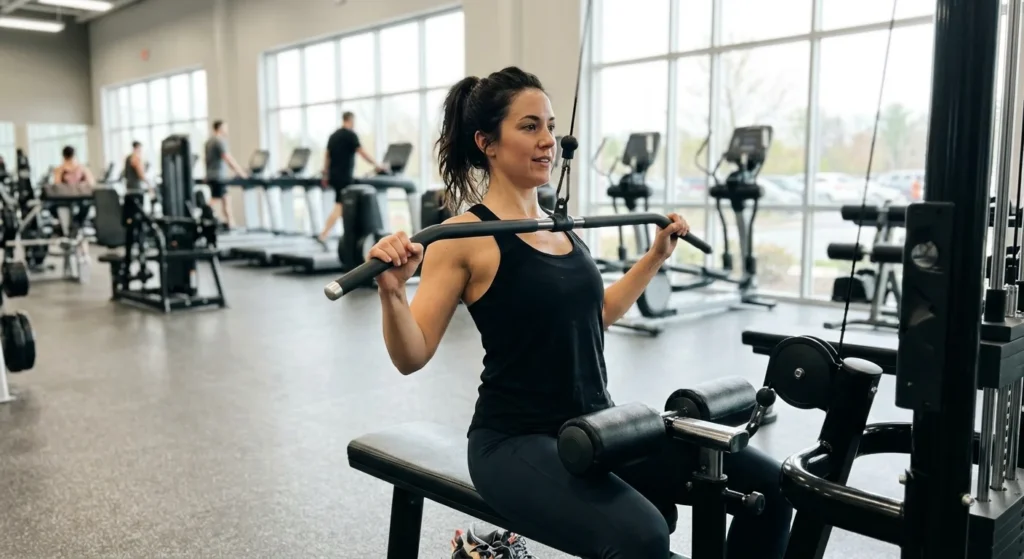
Set the thigh pad snug, grab the bar just outside shoulder width with an overhand grip, and sit tall. Pull the bar to your upper chest while leaning back slightly.
Think about driving your elbows toward your back pockets instead of curling the bar with your hands. Grip choice changes muscle activation, according to a 2002 study by Signorile and colleagues that compared hand positions on the lat pulldown. Pick one grip, learn it, and add weight before you start rotating through variations.
2. Close-Grip Lat Pulldown
Swap the straight bar for a V-bar, or use a shoulder-width underhand grip. Both versions pull your elbows closer to your sides, which changes the path of the lats and brings in more biceps.
Pull the handle to your upper chest and pause for a beat. If your elbows or wrists complain on the underhand grip, the neutral V-bar grip is usually friendlier.
3. Seated Cable Row
Sit with your knees slightly bent, feet on the platform, and a V-handle in both hands. Pull toward your lower ribs and squeeze your shoulder blades together, then let your arms extend fully so your shoulder blades spread a little at the front.
Keep your torso mostly still. A small hip hinge is normal, but rocking back and forth turns the row into a momentum drill and shifts the load to your lower back.
4. Single-Arm Cable Row
Face the pulley with a single handle and row one arm at a time, keeping your elbow close to your side. Your knees stay soft, and your hips stay square.
Training one side at a time exposes strength gaps a two-handed row can hide. Start with your weaker side, then match its rep count on the stronger side.
5. Straight-Arm Pulldown
Set the pulley high with a straight bar or rope, hinge forward slightly, and keep your arms nearly straight. Sweep the handle down to your thighs in an arc, then let it travel back up until you feel the lats stretch.
That stretch matters. A 2020 systematic review by Schoenfeld and Grgic in SAGE Open Medicine found that full range of motion produced similar or better muscle growth than partial range in most comparisons. This move is also a clean warm-up for pulldowns because the biceps contribute very little.
6. Face Pull
Set a rope at about eye level, step back until your arms are straight, and pull toward your face while splitting the rope ends apart. Finish with your hands beside your ears and your elbows high.
Use less weight than feels impressive. Face pulls work the rear delts, rhomboids, and rotator cuff muscles, and heavy sloppy reps turn into a shrug. Pause for one second at the end of each rep.
7. Reverse Cable Fly
Set both pulleys at shoulder height and cross the cables so your right hand holds the left handle. With a slight bend in your elbows, sweep both arms wide until they line up with your shoulders.
Rear delts are small, so keep the weight light and the tempo slow. No dual pulley? Do the movement one arm at a time with a single handle.
8. Cable Shrug
Set the pulley at its lowest position and attach a straight bar or rope. Stand tall with your arms straight and shrug your shoulders straight up toward your ears, then lower with control.
Skip the shoulder rolls. Moving straight up and down keeps the work on your upper traps, and sets of 10 to 15 reps are a good range.
9. Cable Pull-Through
Set the pulley low, face away from the machine, and hold a rope between your legs. Push your hips back with a flat back, then drive them forward to stand tall.
Your glutes and hamstrings do most of the work, while your spinal erectors hold your spine steady. It is not a pure lower back exercise, but it trains the hip hinge without loading your spine with a heavy barbell.
Which Cable Attachments You Need
Four attachments cover every move above: a straight bar, a V-handle, a rope, and a single D-handle. Most commercial gyms in the United States keep all four near the cable stations, and a home station usually ships with at least two.
Each one changes the feel of a pull. A straight bar locks your hands in place and suits heavy pulldowns, while a rope lets your hands separate, which is why it works for face pulls and straight-arm work. The V-handle gives a neutral grip that tends to be easier on the wrists and elbows. The single handle is for unilateral rows and flies.
If you are choosing equipment for a home gym, check the pulley positions and the stack weight before you buy. A station that only moves between two heights will limit which cable back exercises you can do.
How Many Sets, Reps, and Days a Week
The Physical Activity Guidelines for Americans, 2nd edition, from the U.S. Department of Health and Human Services, recommend muscle-strengthening activity for all major muscle groups on two or more days per week. Back training fits inside that easily.
For muscle growth, volume matters. A 2017 meta-analysis by Schoenfeld, Ogborn, and Krieger in the Journal of Sports Sciences found a dose-response relationship between weekly sets and muscle gain, with the largest gains in groups doing 10 or more weekly sets per muscle group. Splitting those sets across two days is an easy way to get there without one marathon session.

Use 6 to 10 reps on heavy pulls like pulldowns and rows, and 12 to 20 on face pulls, flies, and shrugs. Finish most sets with one to three reps left in the tank. Once you hit the top of the rep range on every set, add the smallest weight increment the stack allows.
Two Sample Cable Back Workouts
Do Workout A and Workout B on separate days, for example Monday and Thursday. Warm up with five minutes of easy movement and one light set of your first exercise. Rest 90 to 120 seconds after heavy pulls and 45 to 60 seconds after isolation work.
Workout A: Width and Thickness
- Lat pulldown, 3 sets of 8 to 10
- Seated cable row, 3 sets of 8 to 10
- Straight-arm pulldown, 2 sets of 12 to 15
- Face pull, 3 sets of 12 to 15
Workout B: Balance and Detail
- Close-grip lat pulldown, 3 sets of 8 to 10
- Single-arm cable row, 3 sets of 10 to 12 per side
- Reverse cable fly, 3 sets of 12 to 15
- Cable shrug, 2 sets of 10 to 15
- Cable pull-through, 2 sets of 12 to 15
Together, that adds up to more than 20 weekly back sets, so beginners should start with two sets per exercise and build up over several weeks.
Common Mistakes That Waste Reps
The biggest one is pulling with your hands. If your biceps burn before your back does, think about moving your elbows instead and lighten the load.
Leaning far back on pulldowns and rows is the next problem. A small lean is fine, but a big swing means the weight is too heavy for your back to move alone.
Many lifters also shrug on pulldowns. Start each rep by pulling your shoulder blades down and back, then bend your arms.
Finally, a short range of motion cuts the stretch that helps lats grow. Let the handle pull your arms fully forward or overhead before each rep, as long as your shoulders feel comfortable.
Should You Train Back With Cables Only?
For most people, cables work best as the core of a back day alongside free weights. You usually cannot load cables as heavy as a barbell, and lifts like the deadlift, bent-over row, and pull-up train more muscle at the same time.
Cable-only back training still makes sense in a few cases, and cable back exercises are easy to scale for any level. Beginners often learn cable movements faster, and most cable exercises put little load on the spine, which helps when your lower back is irritated. Hotel gyms and small home setups often have a cable station when they have little else.
If shoulder or back pain shows up during any of these moves, stop and have a physical therapist or doctor check it before you push through.

Start with the cable back exercises that feel most natural, keep your form tidy, and add weight slowly. A few months of consistent pulls will show up in your posture and your lifts well before it shows in the mirror.