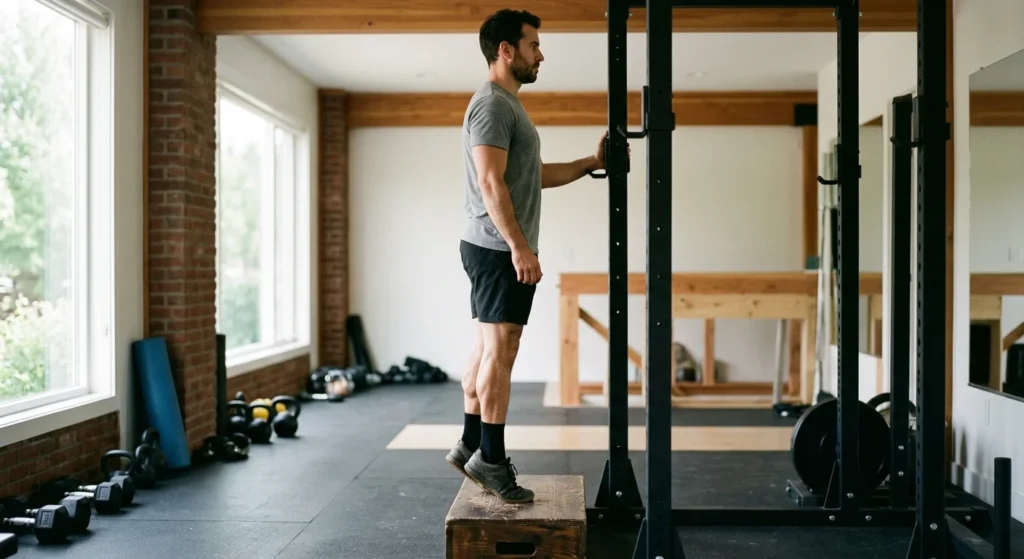

Standing calf raises are done by rising onto the balls of your feet with straight knees, pausing at the top, and lowering slowly until your heels drop below the step. Most people do well with 3 to 4 sets of 8 to 15 slow reps, two to three times a week, using the full range of motion.
The movement looks too simple to need instructions, which is why so many people bounce through half reps and wonder why their calves never change. This guide covers form, what the exercise trains, how to load it, and the mistakes that stall progress.
What Standing Calf Raises Train
Your calf is two muscles. The gastrocnemius is the larger one you see from behind, and it crosses both the knee and the ankle. The soleus sits underneath and crosses only the ankle.
Because the gastrocnemius crosses the knee, it produces the most force when the knee is straight. That is why the standing version loads it harder than a seated calf raise, where the bent knee takes slack out of the gastrocnemius and pushes more of the work onto the soleus.
A good calf routine uses both positions. Both muscles join the heel through the Achilles tendon, so every rep also loads that tendon, which is helpful when you build up gradually and irritating when you jump volume overnight.
How to Do a Standing Calf Raise Step by Step
Use a sturdy step, a weight plate, or a stair edge. Hold a wall or rail with one hand if your balance is shaky.
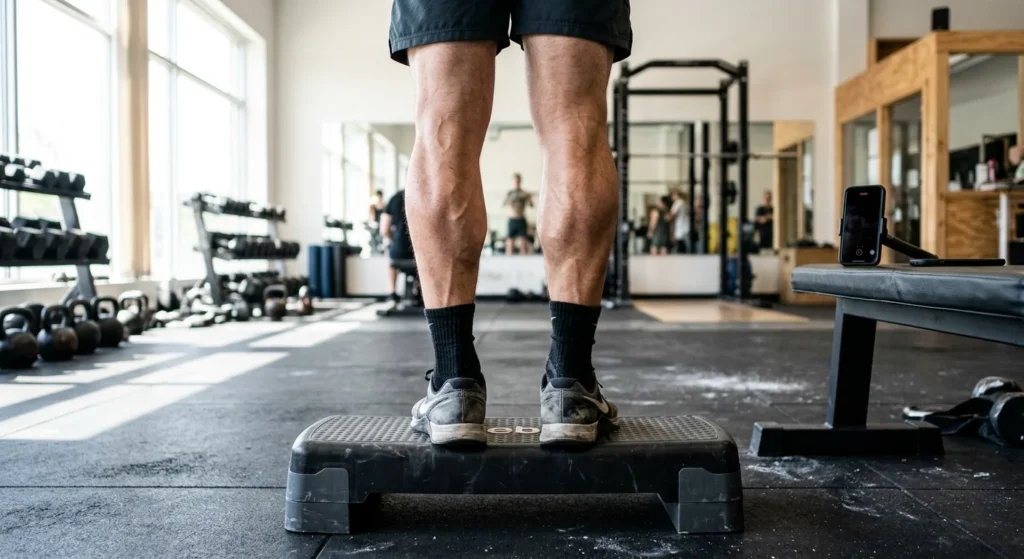
- Place the balls of your feet on the edge of the step with your heels hanging off, feet about hip-width apart and pointing straight ahead.
- Start at the bottom with your heels below the step and your knees straight but not locked.
- Press up through the ball of the foot, with the most pressure under the big toe, and rise as high as you can.
- Pause for one second at the top and squeeze.
- Lower over about three seconds until you feel a full stretch in the calf.
Keep your hips stacked over your ankles and your torso tall. Leaning forward shortens the range and turns the movement into a shuffle. If you only have a floor, the exercise still works, but you lose the deep stretch at the bottom, which is a large part of the benefit.

Think of the movement as a slow rise and a slower drop. A useful cue is to imagine pushing the floor away through the knuckle of the big toe, which keeps the ankle from rolling outward.
Sets, Reps, and Tempo That Work
Calves handle high volume because they work all day when you walk and stand. Many people grow them well with 10 to 20 reps per set, though heavier sets of 6 to 10 also work.
Load matters less than effort and range. A 2017 meta-analysis by Brad Schoenfeld and colleagues in the Journal of Strength and Conditioning Research found similar muscle growth with light and heavy loads when sets were taken close to failure.
Aim for 3 to 4 sets, two or three days a week, with 60 to 90 seconds of rest. Stop each set when you can no longer reach the top position or hold the pause. If your last rep looks like your first, add weight or slow the lowering phase.
Standing Calf Raise Variations
1. Bodyweight Calf Raises on a Step
Start here if you are new to training or returning from a layoff. Get 15 clean reps with a full stretch and a one-second pause before adding any load.
2. Single-Leg Calf Raises
Standing on one foot doubles the load on that calf without any equipment. It also exposes strength differences between sides, which are common. Hold a wall for balance and keep the other foot off the ground, not resting on the ankle.
3. Dumbbell Calf Raises
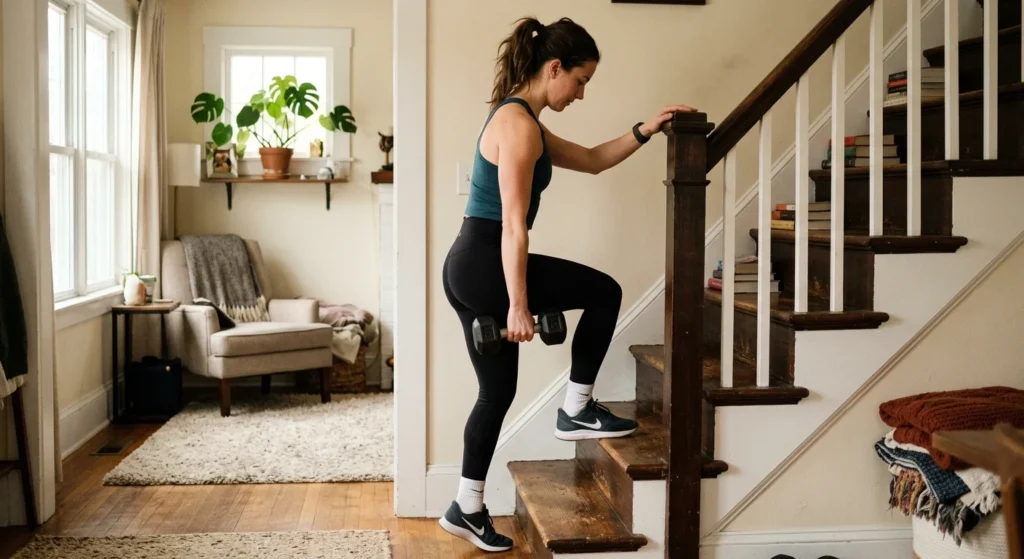
Hold a dumbbell in one hand and use the other hand for balance, working one leg at a time. This is the cheapest way to add serious load at home, and it scales until your grip or the dumbbell runs out.
4. Machine and Smith Machine Calf Raises
A standing calf machine or Smith machine lets you load the movement with a bar across the shoulders and removes most of the balance demand. Place a low platform under the balls of your feet, and keep the bar path vertical. This is where most lifters do their heaviest sets.
5. Donkey Calf Raises
With your torso hinged forward and the load on your hips, this version gives a long, deep stretch. It needs a partner, a machine, or a belt setup, so most people skip it, but it suits anyone who wants extra range.
Test Your Calf Strength Before You Program
A simple test shows where you stand. Stand on one leg, hold a wall lightly for balance, and perform as many full-range heel raises as you can at a steady pace.
Lunsford and Perry described the standing heel-rise test in Physical Therapy in 1995, and healthy adults in their study managed roughly 25 repetitions. A large gap between your two legs is worth noticing, since it can point to a weakness that deserves extra work on the weaker side.
If you manage fewer than 10 with clean form, I would start with two-leg bodyweight sets and build up. If you reach 25 easily, you are ready for loaded single-leg work.
A Simple Progression Ladder
| Stage | Setup | Move On When |
| 1 | Two-leg bodyweight on the floor | 3 sets of 15 with a pause |
| 2 | Two-leg bodyweight on a step | 3 sets of 15 with a full stretch |
| 3 | Single-leg bodyweight on a step | 3 sets of 12 per side |
| 4 | Single-leg with a dumbbell | 3 sets of 12 with a 3-second lowering |
| 5 | Machine or Smith machine | You reach the top of your rep range |
Move up only when the previous stage feels controlled. Rushing the ladder is the quickest way to an irritated Achilles tendon.
Common Mistakes With Standing Calf Raises
1. Bouncing at the Bottom
Bouncing uses the stretch reflex and the Achilles tendon as a spring, so the calf muscle does less. Slow the lowering and pause briefly at the bottom to remove the rebound.
2. Cutting the Range Short
Quarter reps are the most common version of this exercise. Drop the heels fully, rise fully, and use less weight to do it. A lighter, complete rep usually builds more than a heavy partial one.
3. Rolling to the Outside of the Foot
When fatigue sets in, the ankles tend to roll outward and the load slides off the big toe. Film a set from behind once to check. If your ankles collapse, lower the weight before you try to fix anything else.
4. Locking the Knees
Slightly soft knees keep the load on the calf instead of the joint. Bending them noticeably turns it into a partial seated raise, so aim for straight without snapping back.
5. Adding Volume Too Fast
Doubling your sets in one week is a common trigger for sore Achilles tendons and tight calves. Add a set or two at a time, and keep an eye on how the tendon feels the morning after.
Sets, Reps, and Tempo That Work
Calves handle high volume because they work all day when you walk and stand. Many people grow them well with 10 to 20 reps per set, though heavier sets of 6 to 10 also work.
Load matters less than effort and range. A 2017 meta-analysis by Brad Schoenfeld and colleagues in the Journal of Strength and Conditioning Research found similar muscle growth with light and heavy loads when sets were taken close to failure.
Aim for 3 to 4 sets, two or three days a week, with 60 to 90 seconds of rest. Stop each set when you can no longer reach the top position or hold the pause. If your last rep looks like your first, add weight or slow the lowering phase.
Standing Calf Raise Variations
1. Bodyweight Calf Raises on a Step
Start here if you are new to training or returning from a layoff. Get 15 clean reps with a full stretch and a one-second pause before adding any load.
2. Single-Leg Calf Raises
Standing on one foot doubles the load on that calf without any equipment. It also exposes strength differences between sides, which are common. Hold a wall for balance and keep the other foot off the ground, not resting on the ankle.
3. Dumbbell Calf Raises
Hold a dumbbell in one hand and use the other hand for balance, working one leg at a time. This is the cheapest way to add serious load at home, and it scales until your grip or the dumbbell runs out.
4. Machine and Smith Machine Calf Raises
A standing calf machine or Smith machine lets you load the movement with a bar across the shoulders and removes most of the balance demand. Place a low platform under the balls of your feet, and keep the bar path vertical. This is where most lifters do their heaviest sets.
5. Donkey Calf Raises
With your torso hinged forward and the load on your hips, this version gives a long, deep stretch. It needs a partner, a machine, or a belt setup, so most people skip it, but it suits anyone who wants extra range.
Test Your Calf Strength Before You Program
A simple test shows where you stand. Stand on one leg, hold a wall lightly for balance, and perform as many full-range heel raises as you can at a steady pace.
Lunsford and Perry described the standing heel-rise test in Physical Therapy in 1995, and healthy adults in their study managed roughly 25 repetitions. A large gap between your two legs is worth noticing, since it can point to a weakness that deserves extra work on the weaker side.
If you manage fewer than 10 with clean form, I would start with two-leg bodyweight sets and build up. If you reach 25 easily, you are ready for loaded single-leg work.
A Simple Progression Ladder
| Stage | Setup | Move On When |
| 1 | Two-leg bodyweight on the floor | 3 sets of 15 with a pause |
| 2 | Two-leg bodyweight on a step | 3 sets of 15 with a full stretch |
| 3 | Single-leg bodyweight on a step | 3 sets of 12 per side |
| 4 | Single-leg with a dumbbell | 3 sets of 12 with a 3-second lowering |
| 5 | Machine or Smith machine | You reach the top of your rep range |
Move up only when the previous stage feels controlled. Rushing the ladder is the quickest way to an irritated Achilles tendon.
When to Be Careful
Mild calf soreness for a day or two after you start is normal. Sharp pain, Achilles pain that worsens during the session, or pain just above the heel that lingers are reasons to stop and get assessed by a physical therapist or physician.
People with existing Achilles problems sometimes benefit from a structured calf loading program, but it should be tailored. Håkan Alfredson’s widely studied protocol, published in the American Journal of Sports Medicine in 1998, used 3 sets of 15 heel drops with straight and bent knees, twice daily for 12 weeks. It was designed for a specific tendon condition under clinical supervision, not for general fitness.
Sudden swelling, warmth, or pain in one calf, especially without an obvious cause, needs prompt medical attention, since it can signal a blood clot. If you have diabetes, nerve problems in your feet, or balance issues, check with your doctor before starting, and keep a wall within reach.