


Pre-workout can contribute to acne, but it is rarely the only cause. The ingredients most often linked to breakouts are vitamin B12, whey protein blended into some formulas, and sugar, while stimulants like caffeine have little direct evidence behind them. So does pre-workout cause acne on your chest, back, or jawline? It depends on the tub in your hands and the skin you bring to the gym.
This guide walks through each common ingredient, what research actually shows, and how to test your own product without guessing.
Why the Honest Answer Is Sometimes
No large trial has tested pre-workout powders as a category against acne. What exists is a mix of lab studies, small case series, and dermatology reviews on individual ingredients. That means anyone promising a clean yes or no is overstating the evidence.
Acne forms when oil glands, dead skin cells, and the bacterium Cutibacterium acnes combine to clog and inflame pores. Hormones, diet, friction, and genetics all push on that process. A supplement adds one more push, and it tends to matter most for people whose skin was already prone to breakouts.
Pre-workout formulas also vary widely. A stimulant-only powder has little in common with a blend that includes milk protein and sugar, so the label matters more than the brand name.
Ingredients With a Documented Link to Breakouts
1. Vitamin B12
Many pre workouts list B12 at several thousand percent of the daily value. A 2015 study in Science Translational Medicine by Kang and colleagues found that B12 changed how Cutibacterium acnes behaves on skin, increasing its output of inflammatory compounds called porphyrins.
The study was small, so it does not prove B12 in a supplement will break you out. Case reports in dermatology journals have also described acne-like eruptions after high-dose B12, usually injections. Together they offer a plausible reason why some lifters see flare-ups after switching to a high-dose product.
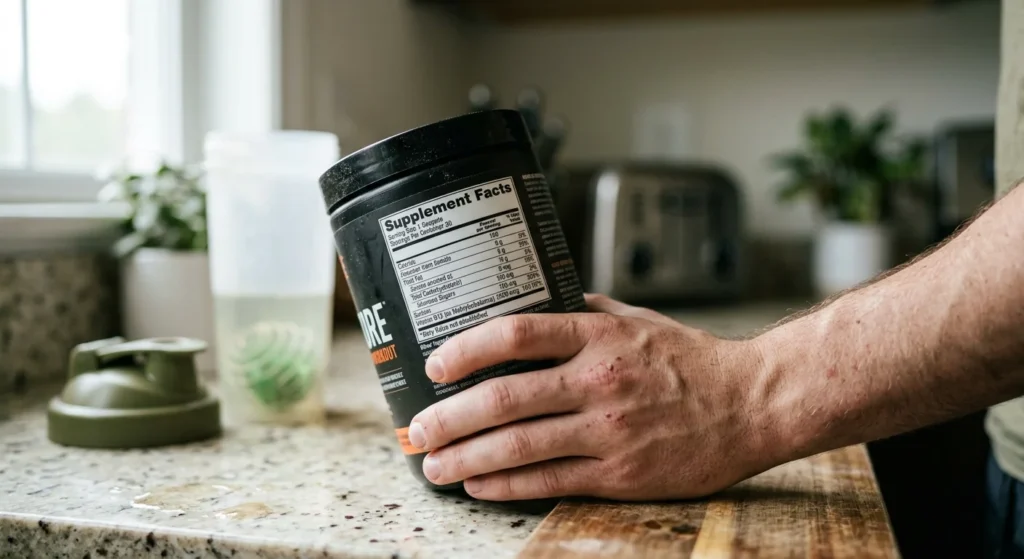
If your skin cleared during a stretch when you used a B12-free powder, that is worth noting.
2. Whey Protein and Other Dairy Ingredients
Whey is not a standard pre workout ingredient, but some blends and many stacks sold alongside them include it. Researchers suspect whey raises insulin and IGF-1 signaling, which can push oil glands to produce more sebum.
A 2012 case series in Cutis by Silverberg described five teenage athletes whose acne worsened after they started whey protein. A 2017 study of male bodybuilders by Cengiz and colleagues, published in Health Promotion Perspectives, also reported an association between whey use and acne on the trunk. A 2018 systematic review by Juhl and colleagues in Nutrients found a positive association between dairy intake and acne, though study quality varied.
None of this shows whey causes acne in everyone. It does mean that if your breakouts started after adding a whey-based product, the protein deserves suspicion before the stimulants do.
3. Sugar and Fast-Digesting Carbs
Some formulas contain dextrose, maltodextrin, or cane sugar for quick energy. A 2007 randomized trial by Smith and colleagues in the American Journal of Clinical Nutrition found that young men who followed a low glycemic load diet for 12 weeks had fewer acne lesions than a comparison group.
A single scoop adds little glycemic load on its own. It becomes relevant when it sits on top of energy drinks, sweetened shakes, and a diet already heavy in refined carbs. Sugar-free options avoid the question entirely.
4. High-Dose Biotin and Other B Vitamins
Some pre workouts add biotin or vitamin B5 alongside B12. Dermatologists have speculated that very high biotin intake could interfere with B5 use in skin, but this idea rests on limited evidence. Treat it as a possibility, not a finding.
Ingredients That Get Blamed Without Much Evidence
Caffeine
Caffeine raises cortisol for a short time, and stress hormones can worsen acne in some people. No solid trial, however, shows that caffeine at normal pre workout doses causes breakouts. The more realistic problem is a late-day scoop that wrecks your sleep, since poor sleep and chronic stress are both tied to flare-ups.
If you train at 7 p.m. and lie awake until 1 a.m., look at the timing before you blame the ingredient.
Creatine
Creatine is often blamed because a 2009 rugby study by van der Merwe and colleagues in the Clinical Journal of Sport Medicine found that DHT, a hormone linked to oil production, rose after a creatine loading phase. The study did not measure acne, so it cannot show that creatine causes breakouts. Most pre workouts contain only a few grams anyway, and plenty of people take creatine for years with clear skin.
Beta-Alanine and Niacin
Beta-alanine causes a harmless tingling, and niacin can cause a warm red flush. Both can leave your face blotchy for 20 minutes or so, which people sometimes mistake for a rash or breakout. If the redness fades before you leave the gym, it is a reaction to the ingredient and not acne.
Quick Evidence Summary by Ingredient
| Ingredient | What the Research Shows | Link to Acne |
| Vitamin B12 | Lab and case data on skin bacteria and eruptions | Plausible, limited |
| Whey protein | Case series and observational studies | Moderate, mostly observational |
| Sugar | Diet trials on glycemic load | Modest |
| Caffeine | No direct acne trials | Unproven |
| Creatine | Hormone study with no acne outcome | Unproven |
| Beta-alanine, niacin | Tingling and flushing only | Not acne |
| Undeclared steroids | FDA warnings | Strong |
Why the Gym Itself Can Trigger Breakouts
Sometimes the timing of your pre workout and the appearance of acne is a coincidence, because training changes your skin’s environment. Sweat, heat, and friction from bar pads, helmets, straps, and tight tops can cause acne mechanica, a type of acne the American Academy of Dermatology links to pressure and rubbing on skin.
That would explain why breakouts often show up on the shoulders, upper back, and chest, exactly where gear rubs. The AAD advises showering soon after sweating and wearing loose, breathable clothing.
Other habits pile on. Wiping your face with a gym towel, resting on shared benches, touching your face between sets, and sleeping in sweaty clothes all bring oil and bacteria back to skin that is already stressed.
Hormones matter too. Heavy training plus a calorie surplus, a new protein powder, and less sleep changes several variables at once, which is why blaming a single scoop is usually a guess.
When a Supplement Hides Something Stronger
The US Food and Drug Administration has repeatedly warned consumers about workout and bodybuilding products that contain undeclared anabolic steroids or steroid-like compounds. Steroids are a well-known cause of acne, often severe and often on the back and chest.
If you developed sudden cystic breakouts after trying an unfamiliar or imported product, stop using it and check the FDA’s tainted products database. Look for third-party testing seals such as NSF Certified for Sport or Informed Sport, which test for banned substances.
Reputable brands print a full label and do not hide every ingredient behind a proprietary blend. If you cannot see doses, you cannot work out what is affecting your skin.
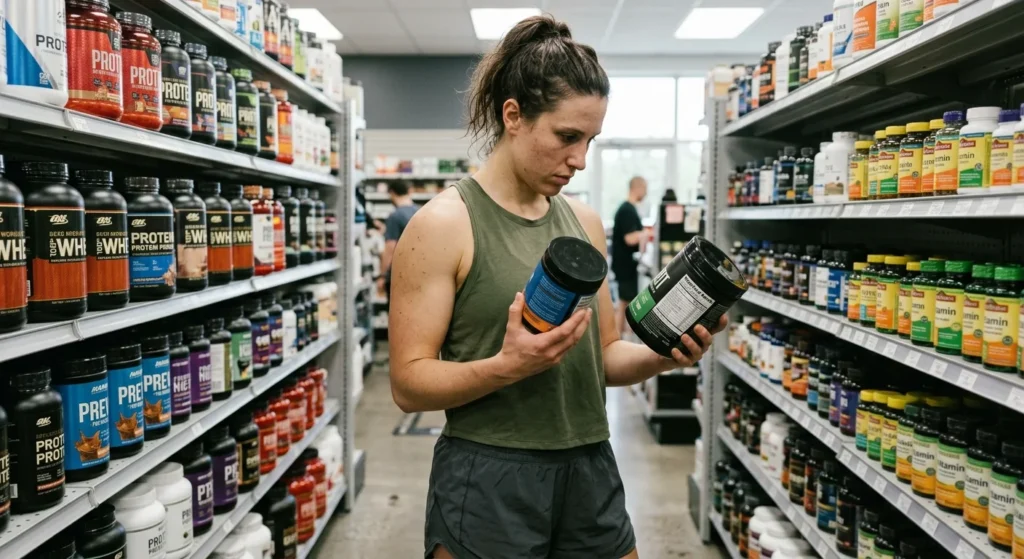
How to Read a Pre Workout Label for Skin Triggers
Start with the vitamin panel and check the B12 line. For context, the NIH Office of Dietary Supplements lists the daily need for B12 in adults at 2.4 micrograms, so a product listing hundreds or thousands of micrograms is far past that.

Then scan for whey, casein, or milk protein, and look at grams of sugar per serving. Words like DHEA, prohormone, or SARM on something sold as a pre workout are a reason to put the tub back, since androgen-related compounds are a known cause of acne.
Who Is Most Likely to Notice a Problem
People who already have acne or a family history of it are the most likely to notice a change. Teenagers and young adults, whose oil glands are more active, also tend to react faster. Oily or combination skin gives breakouts more to work with. If your skin has stayed clear through years of hard training and a new tub suddenly changes things, the new tub is a better suspect than the gym.
Stacking is another factor. Someone who adds a pre workout, whey isolate, creatine, and a multivitamin in the same month has four possible triggers and no way to tell which one did it.
How to Test Whether Your Pre Workout Is the Cause
You can run a simple experiment at home. Acne lesions take weeks to form and heal, so judge results over 6 to 8 weeks, not a few days.
- Take clear photos of your face, chest, and back in the same lighting before you change anything.
- Read the label and note the B12 dose, any whey or milk protein, and sugar per serving.
- Switch to a stimulant-only or B12-free product, and keep your training, diet, and skincare the same.
- Compare photos every two weeks.
- If skin improves, reintroduce the old product alone and watch for a return of breakouts over the following weeks.
This is not a clinical trial, and one person’s result is not proof. It is still the most practical way to separate the supplement from everything else in your routine.
How Long Until Skin Improves After You Stop
If a product was the trigger, expect gradual change, not overnight results. Existing lesions need time to heal, and new ones stop forming at their own pace. Most people should see a clear direction within 6 to 8 weeks.
If nothing moves after that, the supplement was probably not the main driver. That is the point to look at friction, diet, sleep, or medical causes.
Ways to Lower Your Risk Without Quitting Training
Small changes cover most of the ground.
- Pick a formula with a modest B12 dose or none, and check that no whey or milk protein is hidden in the ingredient list.
- Choose sugar-free versions if you also drink sweetened shakes or energy drinks.
- Take your scoop earlier in the day so caffeine does not cut into your sleep.
- Shower and change soon after training, especially if your gear sits against your back or shoulders.
- Wipe down shared equipment contact points and use your own clean towel.
- Use a non-comedogenic moisturizer and an oil-free sunscreen, and avoid picking at lesions.
- Consider a salicylic acid or benzoyl peroxide wash after workouts if you are prone to body acne.
When to See a Dermatologist
Book an appointment if you have painful nodules or cysts, breakouts that leave scars or dark marks, or no improvement after 8 to 12 weeks of consistent changes. A dermatologist can treat acne while you keep training and can check whether a prescription or another supplement is involved. If you suspect steroid contamination, tell them, since that changes the treatment plan.