
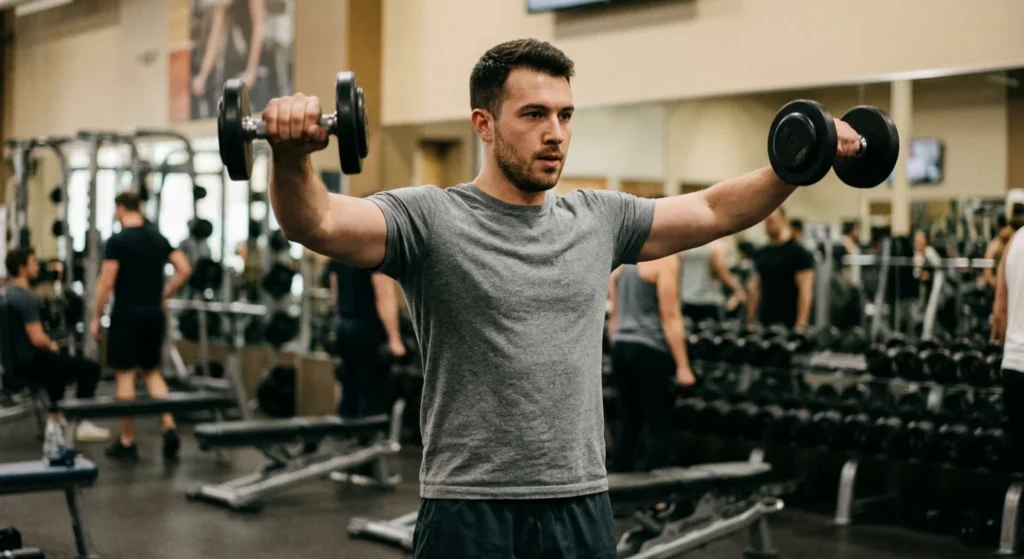

Lateral raises are a shoulder exercise in which you lift your arms out to your sides, usually holding dumbbells, until your hands reach about shoulder height. The movement targets the side deltoid, the muscle that gives your upper body width. If you have been asking what lateral raises are and why nearly every shoulder routine includes them, the answer is simple: few exercises isolate the side delts as directly.
This guide covers the muscles involved, step-by-step form, common mistakes, variations, and how many sets and reps most lifters should use. Weights are listed in pounds, since most US gyms stock dumbbells that way.
Muscles Worked by Lateral Raises
The deltoid has three heads: anterior (front), lateral (side), and posterior (rear). Lateral raises mainly train the lateral head, which is the primary mover when your arm lifts away from your body (shoulder abduction).
Several smaller muscles help. The supraspinatus, a rotator cuff muscle, starts the first part of the lift, roughly the first 15 degrees, according to most anatomy references. The upper trapezius and serratus anterior then help rotate the shoulder blade as your arm rises. Your forearms hold the weight, and your core keeps your torso still.
The exercise also works through a long lever arm. Your arm is nearly straight, and the dumbbell sits far from the shoulder joint, so even a light weight creates a lot of turning force. That is why 10 pounds feels harder than you expect, and why heavier weights tend to ruin form.
Pressing exercises such as the bench press and overhead press load the front delts heavily, so the side delts often fall behind. Exercise libraries from groups like the American Council on Exercise (ACE) list the lateral raise as a deltoid isolation move for this reason.
How to Do a Standing Dumbbell Lateral Raise
The standing dumbbell version is the best place to start. Light weight and clean reps matter more than the number on the dumbbell.
Setup
Stand with your feet about hip-width apart and a dumbbell in each hand at your sides, palms facing your thighs. Soften your knees, brace your abs, and let your shoulders sit down and away from your ears. Bend each elbow slightly and keep that angle for the whole set.
The Lift
Raise both arms out to the sides, leading with your elbows and letting your hands follow. Angle the movement about 30 degrees in front of your torso, in what trainers call the scapular plane. Many people find this path easier on the shoulder joint than lifting straight out to the side.
Stop when your upper arms reach shoulder height and pause for a beat.
The Lowering Phase
Lower the weights over two to three seconds, slower than you lifted them. Do not let them drop or swing at the bottom. Exhale as you lift, inhale as you lower, and keep your ribs down so your lower back stays neutral.

Benefits of Lateral Raises
The most visible benefit is shoulder width. Well-developed side delts make the shoulders look rounder, and the waist look narrower, which is why physique athletes train them several times a week.
Lateral raises are also easy to learn and use light weights. A pair of 10-pound dumbbells is enough for many beginners, so the exercise puts far less load on your joints than a heavy overhead press. They fit nearly any setting too, whether that is a commercial gym, adjustable dumbbells at home, or a resistance band in a hotel room.
They help balance your shoulder development as well. If your routine is full of presses and push-ups, adding side delt work gives the middle of the shoulder its share of training. The Physical Activity Guidelines for Americans, published by the US Department of Health and Human Services, recommend muscle-strengthening activity for all major muscle groups on at least two days per week, and the shoulders are included.
Stronger side delts can support your overhead lifting, but the raise does not replace pressing.
Common Lateral Raise Mistakes
1. Using Momentum
Swinging the dumbbells up with your hips and back is the most common error. It moves the work off the side delt and onto your lower back. If you need to lean or bounce to finish a rep, the weight is too heavy.
2. Shrugging Your Shoulders
When the load is too heavy, the upper traps take over, and your shoulders creep toward your ears. Think about lengthening your neck and pushing the dumbbells out to the sides. Dropping the weight by 2.5 to 5 pounds usually fixes it.
3. Lifting Too High
Raising your arms well above shoulder height adds little for the side delt and increases trap involvement. That position can also pinch the tissues at the top of the shoulder in some people. Stop at shoulder level.
4. Rotating the Hands Too Far
Turning your thumbs down, as in the old “empty can” position, internally rotates the shoulder and can irritate the rotator cuff tendons. Keep your palms facing the floor or slightly inward, and hold the dumbbells level.
5. Locking the Elbows or Bending Them Too Much
Locked-out elbows can strain the joint. A deep bend shortens the lever and makes the lift easier than intended. Keep a slight, steady bend from the first rep to the last.
Lateral Raise Variations
Once the standard version feels solid, a few variations change where the exercise feels hardest.
1. Cable Lateral Raise
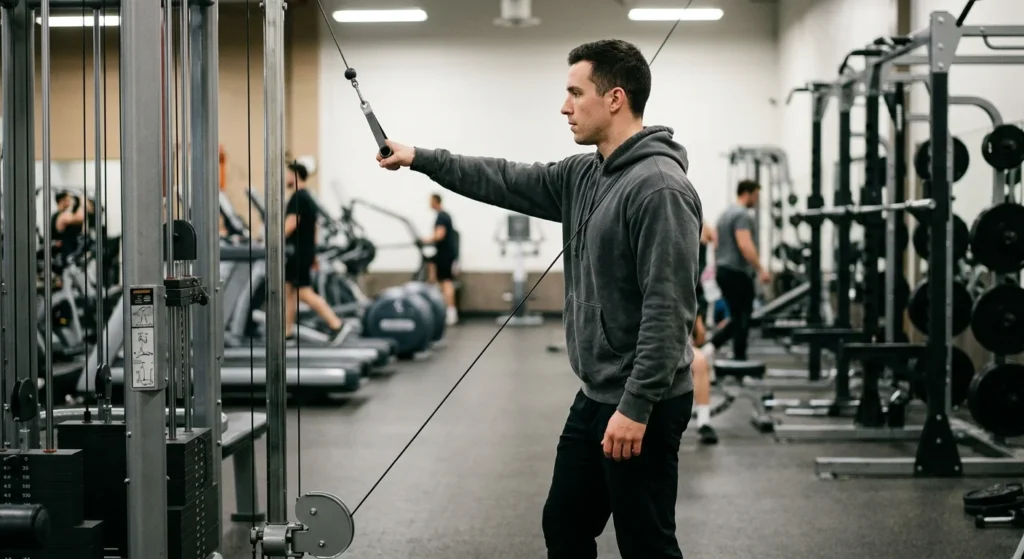
A cable keeps tension on the muscle at the bottom of the rep, where dumbbells are easiest because your arm hangs straight down. Set the pulley low and use the hand farthest from the stack. It is also easy to add small weight increments.
2. Seated Dumbbell Lateral Raise
Sitting on a bench removes leg drive and makes cheating harder. It suits beginners and anyone who tends to swing the weights.
3. Lean-Away Lateral Raise
Hold an upright with one hand and lean your body away from it, then raise the free arm. The lean shifts the hardest point of the lift toward the bottom of the rep and lengthens the range of motion.
4. Machine and Resistance Band Versions
Lateral raise machines guide the path, which helps if you are new to the movement. Bands work at home, though resistance climbs as the band stretches, so the top of the rep is the hardest part.
How Much Weight, How Many Sets and Reps
Start lighter than you think. Most beginners do well with 5 to 10 pounds per hand, and many intermediate lifters work in the 10 to 25 pound range. The side delt is a small muscle, so even a 2.5-pound jump can feel large.
For volume, 2 to 4 sets of 10 to 20 reps works well for most people. The American College of Sports Medicine (ACSM) position on resistance training progression suggests 8 to 12 repetitions as a starting range for novices. Lateral raises often sit at the higher end of that range or above, because heavy loads encourage cheating.
A simple method is double progression. Pick a rep range such as 10 to 15, and add weight only after you hit 15 reps on every set with clean form.
You can train them two to three times per week, since the muscle recovers quickly from light work. Stop each set when your form starts to break down, not when you reach a target number.
Where Lateral Raises Fit in a Workout
Place lateral raises after your heavy compound lifts. If you do them first, tired side delts can limit your overhead press and bench press. On a push day, they usually come after pressing and before triceps work.
A simple shoulder session might look like this:
- Overhead press, 3 sets of 6 to 10 reps
- Lateral raises, 3 sets of 12 to 15 reps
- Rear delt fly, 3 sets of 12 to 15 reps
Some lifters pair lateral raises with rear delt flys as a superset to save time. If side delts are a priority, a second, lighter session later in the week is an option.
Lateral Raises Compared With Other Shoulder Exercises
The overhead press builds overall shoulder and triceps strength with heavy loads, but the front delts and triceps do much of the work. Lateral raises use light loads and isolate the side delt. The two work best together.
Front raises mainly train the front delt, which already gets plenty of work from pressing, so most programs can skip them. Upright rows hit the side delts and traps, but the internal rotation at the top bothers some shoulders. A wide-grip or cable version is a gentler option.
Rear delt flyes cover the back of the shoulder and pair well with lateral raises for balanced delts.
A Simple Way to Check Your Form
Film a set from the front and from the side with your phone. From the front, both arms should rise at the same speed and stop at the same height. From the side, your torso should stay upright, with no backward lean at the top.

Then run a quick test: if you can pause for one full second at the top of every rep, the weight is probably right. If you cannot, drop 2.5 to 5 pounds. Reviewing a short clip every week or two catches sloppy habits before they set in.
Who Should Be Careful With Lateral Raises
Skip or modify the exercise if you have current shoulder pain, a recent injury, or a history of rotator cuff trouble or impingement. A dull burn in the side of the shoulder is normal. Sharp or pinching pain in the joint is not, and you should stop.
This article is general fitness information and not medical advice. Check with a doctor or licensed physical therapist before starting if you have a shoulder condition, and consider a certified trainer for an in-person form check.