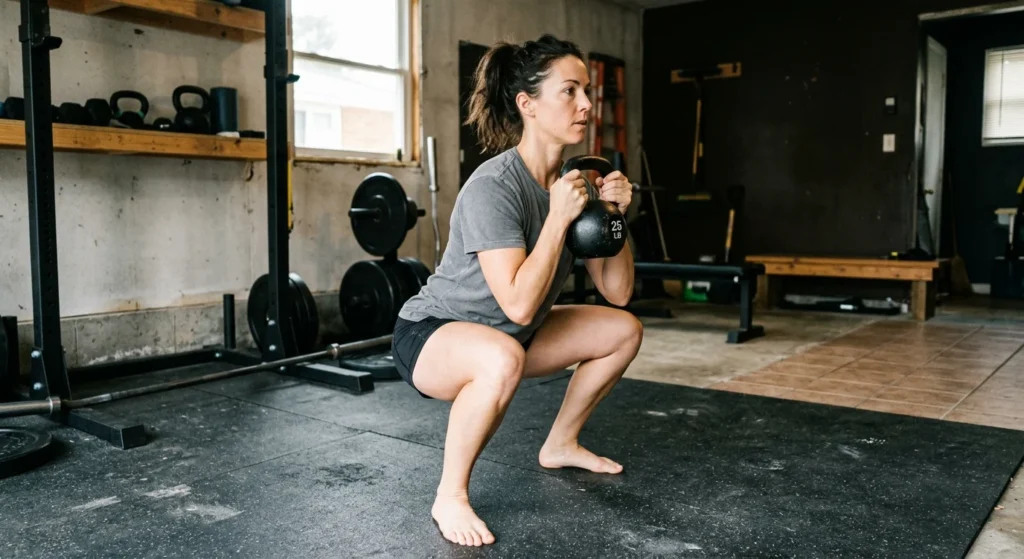

A goblet squat is a squat where you hold one dumbbell or kettlebell against your chest, sit down between your hips, and stand back up. It works your quads, glutes, and core, and the weight in front helps you stay upright, which makes it one of the easiest squats to learn.
This guide covers setup, step-by-step form, how heavy to go, the mistakes that show up most often, and a four-week plan you can run with a single weight. Everything here is written for the typical US gym or home setup, with weights in pounds.
Why the Goblet Squat Is Easier to Learn Than a Barbell Squat
Strength coach Dan John popularized the movement and has described using it to teach athletes who struggled to squat well with a barbell. The weight held at your chest works as a counterweight. It pulls you slightly forward, so your torso stays tall and your hips drop between your feet with very little coaching.
That counterweight is the main reason many trainers in American gyms start new clients here. A barbell back squat asks you to carry a loaded bar, brace hard, and hit depth all at once. The goblet version lets you practice the pattern before you add those demands.
It also fits almost any space. One dumbbell or kettlebell is enough, which suits a spare bedroom, a hotel fitness room, or a packed commercial gym at 6 p.m. And because the load sits in front, you can drop it safely if a rep goes wrong, with no bar to get pinned under.
Muscles Worked by the Goblet Squat
The main drivers are the quadriceps on the front of your thighs and the glutes. Your adductors (inner thighs) and hamstrings help control the way down and share the work on the way up.
The front-loaded weight also puts your trunk to work. Your abs and the muscles along your spine have to resist being pulled forward, while your upper back and shoulders hold the weight in place. On heavier sets, many lifters feel it in their forearms and upper traps too.
That mix explains where the exercise sits. It is more demanding than a bodyweight squat and easier to set up than a barbell squat, so you get real leg and trunk training without a rack or a spotter.
How to Do a Goblet Squat Step by Step
Set Up the Weight and Your Stance
Hold a dumbbell vertically by one end, cupping the top plate, or grip a kettlebell by the horns (the sides of the handle). Bring it close to your breastbone with your elbows pointing down. The weight should rest against your chest instead of hanging away from it.
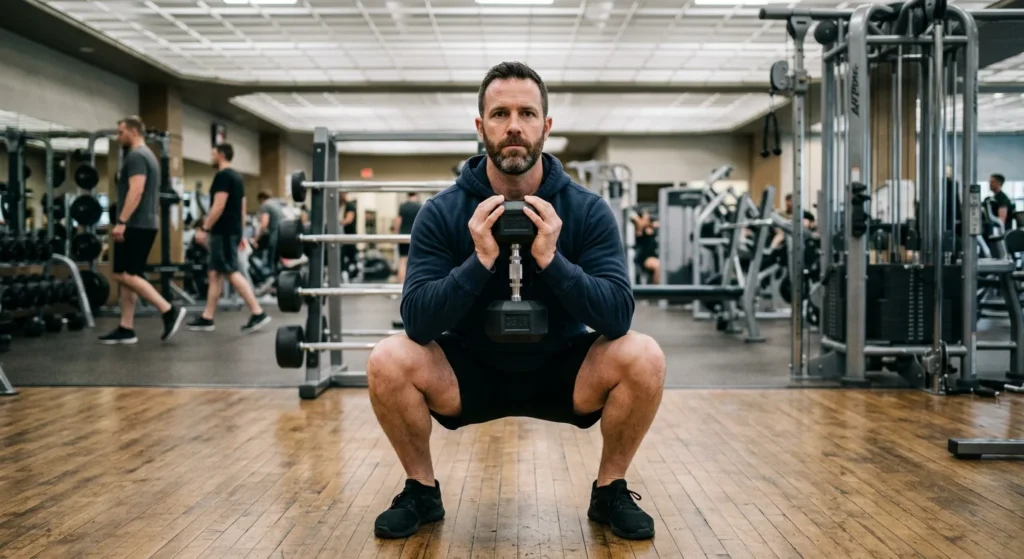
Stand with your feet about shoulder width apart and your toes turned out 15 to 30 degrees. Hip sockets differ from person to person, so adjust the angle until the bottom position feels smooth rather than pinched.
Lower, Pause, and Stand Up
Work through the rep in this order:
- Take a breath into your belly and brace your abs, as if someone were about to poke you in the stomach.
- Start the descent by bending your knees and pushing your hips back at the same time.
- Let your knees track out over your toes while your elbows slide inside your knees.
- Lower until your thighs are parallel to the floor or a bit deeper, as long as your heels stay flat and your back stays neutral.
- Pause for a beat, then press the floor away and stand tall, exhaling as you rise.
Squeeze your glutes at the top and reset your breath before the next rep. A good set looks consistent, with the same speed and depth on rep eight as on rep one.
A Quick Warm-Up Before Your First Set
Spend three to five minutes before you load anything. Do ten bodyweight squats, ten hip circles in each direction, and a 30-second hold in the deep squat position with your hands pressed together at your chest.
Then do one light set of five goblet squats with the pry and pause described below. By the time you pick up your working weight, your hips and ankles are warm, and you know how deep you can go that day.
How Heavy Should a Goblet Squat Be?
Pick a weight that lets you complete 8 to 12 clean reps with two or three reps left in the tank. Common starting points in gym practice are roughly 15 to 25 pounds for newer lifters who are smaller and 25 to 40 pounds for larger ones, but body size, age, and training history shift those numbers a lot. Treat them as a first guess, not a rule.
Many US gyms stock dumbbells in 5-pound steps and kettlebells in 5-pound jumps, so you can usually find something close to what you want. If the next weight up is too heavy, stay with the lighter one and add reps or a slower lowering phase before you move on.
Your grip and upper body set the ceiling on this exercise. If a dumbbell feels easy for 12 reps but you cannot hold anything heavier at your chest, the goblet squat has done its job. Move to front squats, split squats, or a barbell back squat.
Common Goblet Squat Mistakes and How to Fix Them
1. Heels Lifting Off the Floor
If your heels rise, ankle stiffness is usually limiting your depth. Slide a 5- or 10-pound plate or a thin board under your heels, or switch to flat shoes with a firm sole. Cushioned running shoes can feel wobbly under load.
2. Knees Caving Inward
Inward drift usually appears when the weight gets heavier, or your feet are set too narrow. Widen your stance a little and think about spreading the floor apart with your feet. A light resistance band just above the knees gives you something to push against.
3. Rounding the Lower Back at the Bottom
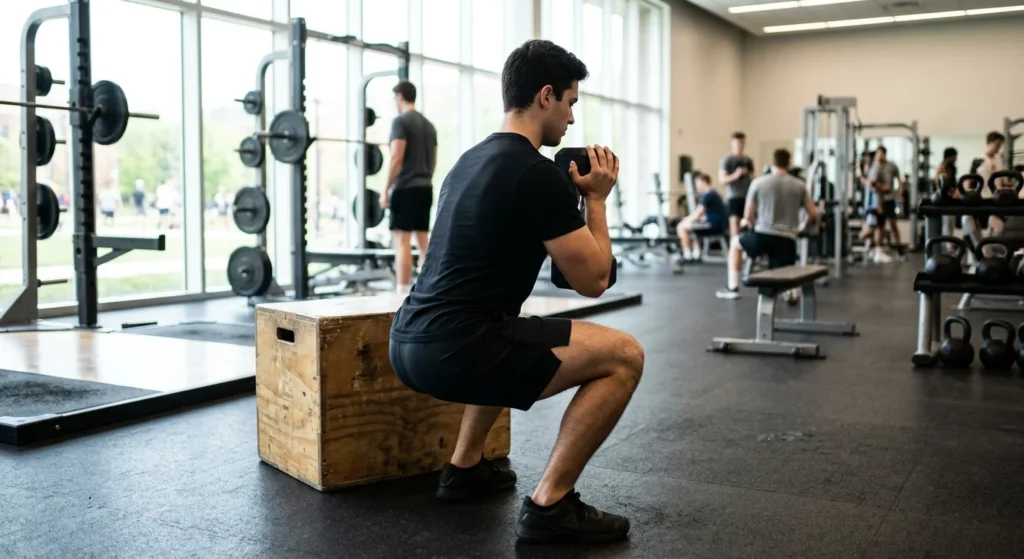
A small tuck of the pelvis at the bottom, often called butt wink, is common, and many coaches only worry when it is large, painful, or happens under heavy load. If it bothers you, stop the descent a couple of inches higher, or squat down to a box as a depth target. Lower the target over a few weeks as your hips loosen up.
4. Letting the Weight Drift Away From Your Chest
When the weight swings forward, your torso folds over and your lower back takes on work your legs should be doing. Pull the weight in, keep your elbows down, and look at a spot on the floor about six feet ahead of you.
5. Bouncing Out of the Bottom
Using the stretch reflex to spring up hides weak positions. Pause for one full second at the bottom on every rep until the habit disappears.
The Pry and Pause Drill for Deeper, Cleaner Reps
Dan John teaches a version of this drill, and it works as both a warm-up and a diagnostic test. At the bottom of an unloaded or light goblet squat, hold the position for 3 to 5 seconds and gently press your elbows into the insides of your knees to nudge them outward. Keep your heels down and your chest tall.
Do three to five of these before your working sets. Your hips open up, and the bottom position starts to feel like a place you can stay instead of a place you pass through.

It also tells you what is holding you back. Try the same squat with your heels on a small plate. If depth and posture improve right away, your ankles are the limit. If nothing changes, your hips or your setup need attention, and the box squat is a good next step.
Goblet Squat vs Front Squat vs Back Squat
The goblet squat holds the weight in front of your chest with both hands, the front squat holds a barbell on your shoulders in front, and the back squat holds the bar across your upper back. The closer the load sits to the front, the more upright your torso needs to be.
Back squats let you move the most total weight, so they suit maximum strength work. Front squats and goblet squats demand a more upright torso and more trunk effort per pound lifted. The goblet squat caps out at what you can hold, which is why it works best as a learning tool, a warm-up, or a main lift for people training at home with light equipment.
None of these is the right answer for everyone. Pick the one that matches your equipment, your goals, and the positions your body handles comfortably today.
Goblet Squat Variations to Try Next
1. Box Goblet Squat
Sit back onto a bench or box set at or just below knee height, touch lightly, and stand up. It gives you a consistent depth target and builds confidence for people who feel unsteady near the bottom.
2. Tempo Goblet Squat
Take three seconds to lower, pause for two, and stand up at normal speed. The slower pace makes a lighter weight feel much harder, which is useful when you only own one dumbbell.
3. Heel-Elevated Goblet Squat
Placing your heels on a small plate shifts more work to the quads and lets you stay upright with less ankle mobility. It suits lifters with long legs or tight calves.
4. Goblet Reverse Lunge
Hold the same position and step back into a lunge. You train one leg at a time, which exposes side-to-side strength differences that a two-footed squat can hide.
How to Program the Goblet Squat
The 2018 Physical Activity Guidelines for Americans, from the US Department of Health and Human Services, recommend muscle-strengthening activity for all major muscle groups on at least two days a week for adults. A goblet squat covers the legs, hips, and trunk, so it fits neatly into the lower-body portion of that target.
Here is a simple four-week progression that uses one weight. In week one, do three sets of eight with a two-second pause at the bottom. In week two, do three sets of ten, and in week three, three sets of twelve.
In week four, keep the same weight and take three seconds to lower on every rep for three sets of eight. If that feels manageable, move up to the next dumbbell or kettlebell and start the cycle again at week one. Rest about 60 to 90 seconds between sets.
Train it two or three times per week, with at least a day between sessions, and pair it with a hinge such as a Romanian deadlift and a push or pull so the rest of your body gets worked too.
When to Modify or Skip the Goblet Squat
Knee pain, hip pain, back pain, recent surgery, and pregnancy all change what a safe squat looks like. If any of these apply, check with a physician or physical therapist before adding load. Pain that sharpens during a rep is a signal to stop, not push through.
This article is general fitness information and not medical advice.
Start light, film one set from the side, and compare your depth and torso angle to the steps above. Most people find that a few weeks of consistent goblet squat practice makes every other squat feel more natural.