


The close grip lat pulldown is one of the most reliable ways to add thickness to your back without loading your spine the way a deadlift or barbell row does. Swap a wide bar for a V-handle or close grip attachment and the exercise shifts noticeably. Your hands sit closer together, your elbows track straight down along your ribs instead of out to the sides, and you get a longer pull that lets your lats stretch and contract through a fuller range.
That single change in hand position affects everything from which muscles do the most work to how much weight you can move and how your shoulders feel the next day. This guide breaks down the exact setup, the muscles involved, the mistakes that quietly cap your progress, and how to fit the movement into a back-focused program.
What Is the Close Grip Lat Pulldown
The close grip lat pulldown is a vertical pulling exercise performed on a cable pulldown machine using a narrow attachment, typically a V-bar, a close neutral grip handle, or a straight bar gripped at shoulder width or tighter. You sit facing the machine, secure your thighs under the pad, and pull the attachment down toward your upper chest while keeping your torso upright.
The narrow hand position is what separates it from a standard lat pulldown. With a wide grip, your elbows flare out and the range of motion shortens because your upper arms hit resistance from your shoulder joint sooner. Bring your hands in close and your elbows can travel further down your sides before that resistance kicks in, so you get a deeper stretch at the top of the movement and a harder squeeze at the bottom.
This exercise works well for almost anyone. Beginners find it easier to learn than pull-ups because the machine controls the resistance path, and lifters who struggle with grip or shoulder mobility on a wide bar often find the close, neutral hand position more comfortable.
Muscles Worked
The close grip lat pulldown is a compound movement, so it recruits several muscle groups at once, though the emphasis shifts depending on your grip.
Primary Movers
Your latissimus dorsi does the bulk of the work. This is the broad, fan-shaped muscle that runs from your mid and lower back up to your upper arm, and it is the muscle most responsible for the “V-taper” look lifters chase. The close grip position lets the lats work through a longer range than a wide grip does, which is a big part of why many people feel a stronger contraction with this variation.
Your biceps brachii also get significant work, more so than in a wide grip pulldown, because the closer hand position and the pulling angle put your elbow flexors in a stronger mechanical position. If you use an underhand close grip instead of a neutral or overhand one, biceps involvement increases further.
Secondary Movers
Your rhomboids and middle trapezius fire to retract your shoulder blades as you pull, which adds thickness to the middle of your back. Your rear deltoids assist toward the bottom of the pull, and your teres major, a smaller muscle that sits just below your shoulder, works alongside the lats throughout the movement.
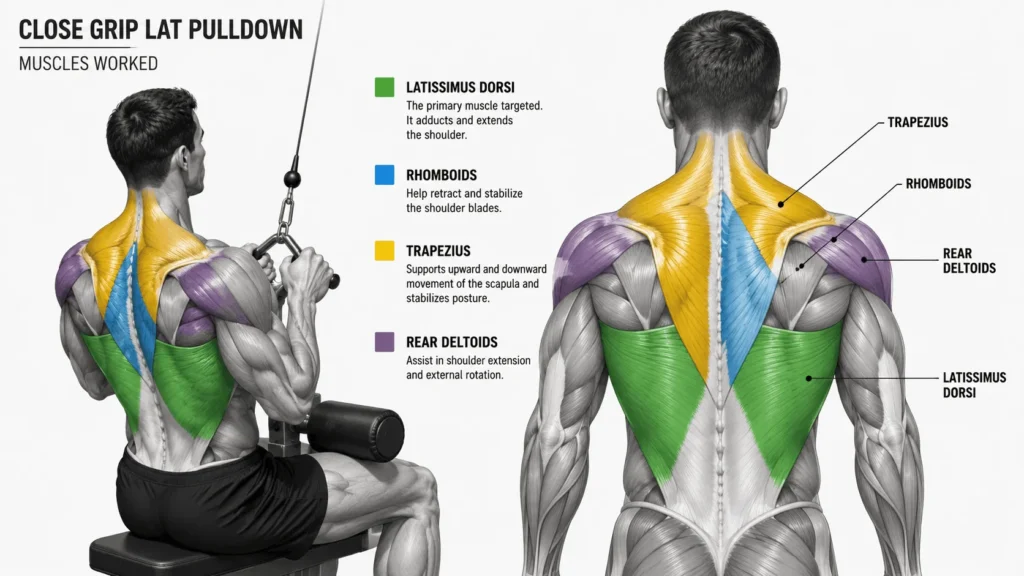
Your core also plays a real role here. Bracing your abs keeps your torso from swinging backward and helps you isolate your back muscles instead of turning the exercise into a standing row.
How to Do the Close Grip Lat Pulldown
1: Setup
Attach a V-bar, close grip handle, or narrow straight bar to the cable. Adjust the thigh pad so it sits snugly against your legs when seated, tight enough that your body stays anchored when you pull heavy but not so tight that it’s uncomfortable. Grab the attachment with your hands roughly 6 to 10 inches apart, using whichever grip orientation you prefer.
Sit down, hook your thighs under the pad, and set your feet flat on the floor. Lean back slightly, no more than 10 to 15 degrees, and lift your chest. Your arms should be fully extended overhead with a slight bend in the elbow before you start the first rep
2: Execution
Initiate the pull by driving your elbows down and back, thinking about pulling your shoulder blades down and together before your arms do much work. Bring the attachment down toward your upper chest or collarbone, keeping your elbows close to your sides rather than letting them drift forward or flare out.
Pause briefly at the bottom and squeeze your back, then extend your arms back to the starting position under control. Let your lats stretch fully at the top before starting the next rep. Avoid letting the weight stack slam down between reps, since that tension on the way up is where a large part of the muscle-building stimulus comes from.
3: Breathing and Tempo
Exhale as you pull the bar down, inhale as you return to the top. A controlled tempo, roughly 1 to 2 seconds on the pull and 2 to 3 seconds on the return, keeps tension on your back muscles instead of letting momentum do the work. If you can complete every rep in under a second each direction, the weight is probably too light for the set to do much good.
Common Mistakes and How to Fix Them
1: Leaning Back Too Far
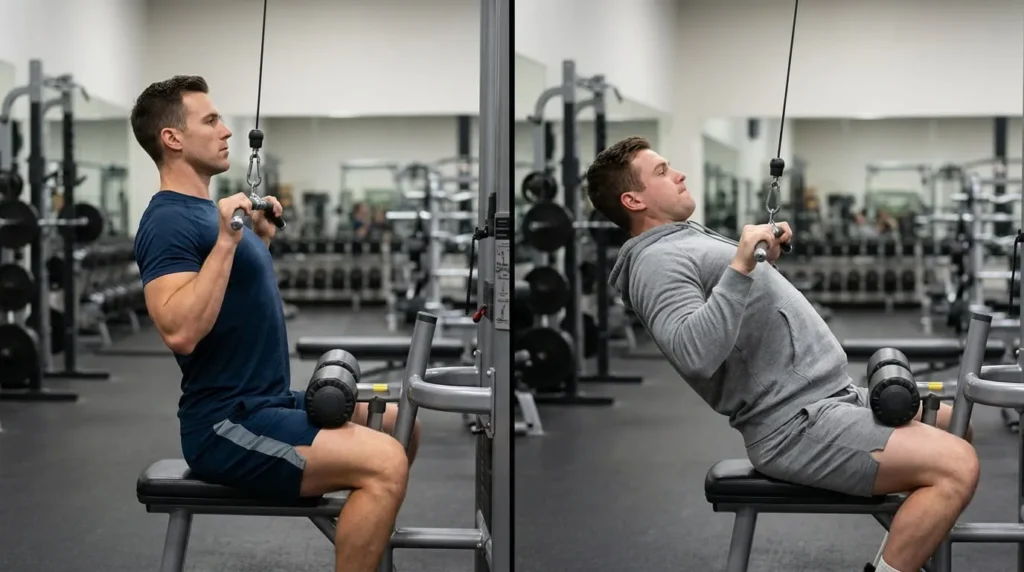
A small lean is fine and even helpful, but rocking your torso back 30 or 40 degrees turns the exercise into something closer to a seated row and shifts load off your lats. Keep the lean minimal and stay tall through your chest.
2: Pulling the Bar Too Low
Bringing the attachment down past your chest and toward your stomach puts unnecessary strain on your shoulder joints without adding any benefit. Stop the bar at your upper chest or collarbone, where your elbows are roughly in line with your torso.
3: Using Momentum
Jerking your upper body backward to help move the weight is one of the most common ways lifters cheat this exercise. It reduces how much your back actually has to work and increases injury risk. If you need to swing to complete a rep, the weight is too heavy.
4: Letting the Biceps Take Over
Because the close grip position already increases biceps involvement, it’s easy to let your arms do most of the pulling instead of your back. Focus on initiating each rep by driving your elbows down rather than curling the bar toward you. Some lifters find that using a false grip, wrapping the thumb alongside the fingers instead of around the bar, helps reduce the urge to grip and curl with the arms.
5: Not Controlling the Eccentric
Letting the weight stack drop on the way up skips the lengthening phase of the movement, which is where a lot of the muscle damage that drives growth actually happens. Control the return every rep.
Close Grip vs Wide Grip Lat Pulldown
The wide grip lat pulldown places your hands well outside shoulder width, which flares your elbows out to the sides and shortens the usable range of motion. It tends to emphasize the upper lats and the width of your back more directly.
The close grip version, by contrast, lets your elbows travel straight down your sides, extending the range of motion and increasing time under tension for the lats through the bottom portion of the pull. Most lifters can also handle more total weight with a close grip because the pulling angle is mechanically stronger, and the added biceps and forearm involvement gives your grip more support on heavier sets.
Neither version is strictly better. Wide grip work targets width, close grip work targets thickness and a fuller stretch, and many well-designed back programs rotate between both across a training block.
Close Grip Lat Pulldown Variations
1:Underhand Close Grip Pulldown
Switching to an underhand grip increases biceps recruitment further and can feel more comfortable for lifters with shoulder mobility restrictions, since the wrist and elbow sit in a more natural rotational position.
2: Single-Arm Close Grip Pulldown
Using a single-handle attachment and pulling one arm at a time helps correct strength imbalances between your left and right lats, since neither side can compensate for the other.
3: Kneeling Close Grip Pulldown
Performing the movement kneeling on the floor with a cable set at a high pulley removes the seated machine’s stability, forcing your core to work harder to prevent your torso from swaying.
Programming Recommendations
For most lifters training for hypertrophy, 3 to 4 sets of 8 to 12 reps works well, leaving 1 to 2 reps in reserve on most sets and pushing closer to failure on the final set. If your goal leans more toward strength and pulling power, 4 to 5 sets of 5 to 8 reps with slightly heavier loads is a reasonable approach.
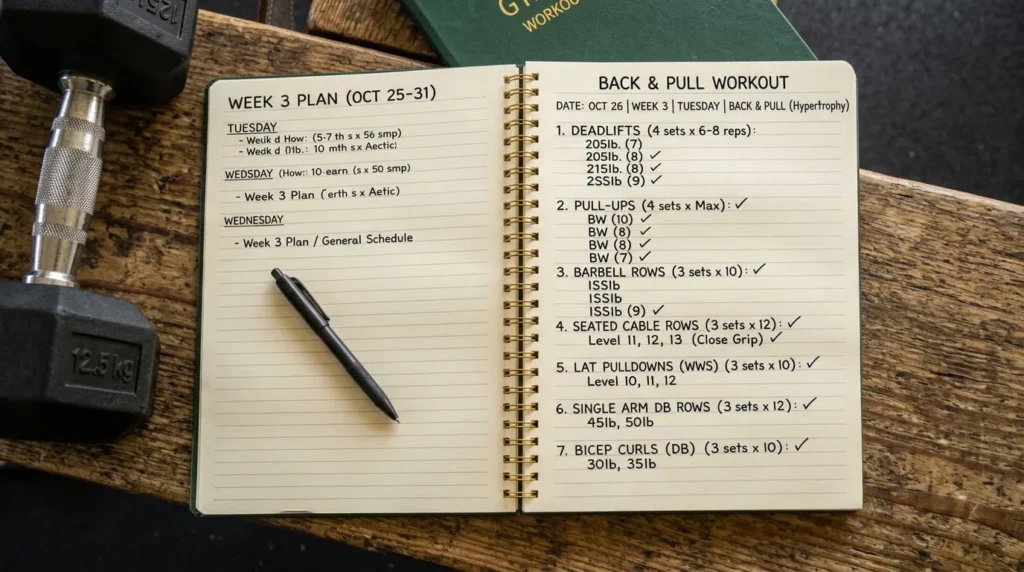
The close grip lat pulldown pairs naturally with horizontal pulling movements like rows, since the two together cover both the vertical and horizontal pulling patterns your back needs for balanced development. Placing it early in a back workout, after a compound movement like a deadlift variation or pull-up but before isolation work, lets you use meaningful weight while your grip and back are still fresh.
If you train back twice a week, alternating close grip and wide grip pulldowns between sessions is a simple way to get the width benefits of one and the thickness benefits of the other without overcomplicating your split.