


A lat pulldown is a cable machine exercise that trains the muscles of your upper back by pulling a bar down toward your chest while seated. It is one of the most common back exercises in any gym, and for good reason. It builds the same pulling strength as a pull-up while letting you adjust the weight to match your current fitness level. This guide explains exactly what the lat pulldown is, which muscles it targets, how to perform it correctly, and which variations are worth adding to your routine.
How the Lat Pulldown Machine Works
The lat pulldown machine consists of a weight stack connected by a cable to an overhead bar. You sit facing the machine, secure your thighs under a padded support, and pull the bar down using your back and arms rather than your body weight.
Because the resistance comes from a stacked cable rather than your own bodyweight, you can start with a lighter load and increase it as you get stronger. This makes the lat pulldown a practical entry point for anyone who cannot yet perform a full pull-up or chin-up. It also allows for controlled negatives, meaning you can slow down the upward return of the bar to add extra time under tension.
Muscles Worked by the Lat Pulldown
The primary target is the latissimus dorsi, the broad muscle that spans the sides of your back from your shoulder blades down to your waist. This is the muscle most responsible for the “V-taper” look many lifters train for.
Several supporting muscles are also active during the movement. The trapezius and rhomboids, located between your shoulder blades, help retract your shoulders as you pull. The teres major assists the lats in shoulder extension, and the biceps brachii contribute noticeably as your elbows bend. Your core also stays engaged throughout to keep your torso stable against the pulling cable.
This combination of muscles is why the lat pulldown is classified as a compound exercise. It moves more than one joint and recruits multiple muscle groups in a single repetition, unlike an isolation exercise that targets just one area.
How to Do a Lat Pulldown With Proper Form
Setting Up
Adjust the thigh pad so it sits snugly against your legs, just above your knees, with your feet flat on the floor. Select a weight that lets you complete your full rep range with control, not one that forces you to lean back excessively to move the bar.
Grasp the bar with an overhand grip slightly wider than shoulder width. Sit tall, brace your core, and let your arms fully extend overhead before starting the first rep.
The Pulling Motion
Initiate the pull by drawing your shoulder blades down and together, rather than yanking with your arms first. Bend your elbows and pull the bar down toward your upper chest, keeping your torso mostly upright with only a slight backward lean.
Pause briefly once the bar reaches chest height, then extend your arms back to the starting position under control. Avoid letting the weight stack drop quickly, since the controlled return is where much of the muscle-building work happens.
Common Lat Pulldown Mistakes
Leaning back too far is the most frequent error. A small lean of 10 to 20 degrees is normal, but leaning back sharply turns the movement into a rowing motion that takes tension off the lats and puts strain on the lower back.
Pulling the bar behind the neck is another common mistake, and one worth avoiding entirely. This position places the shoulder joint in a vulnerable range and offers no real advantage over pulling to the front of the chest.
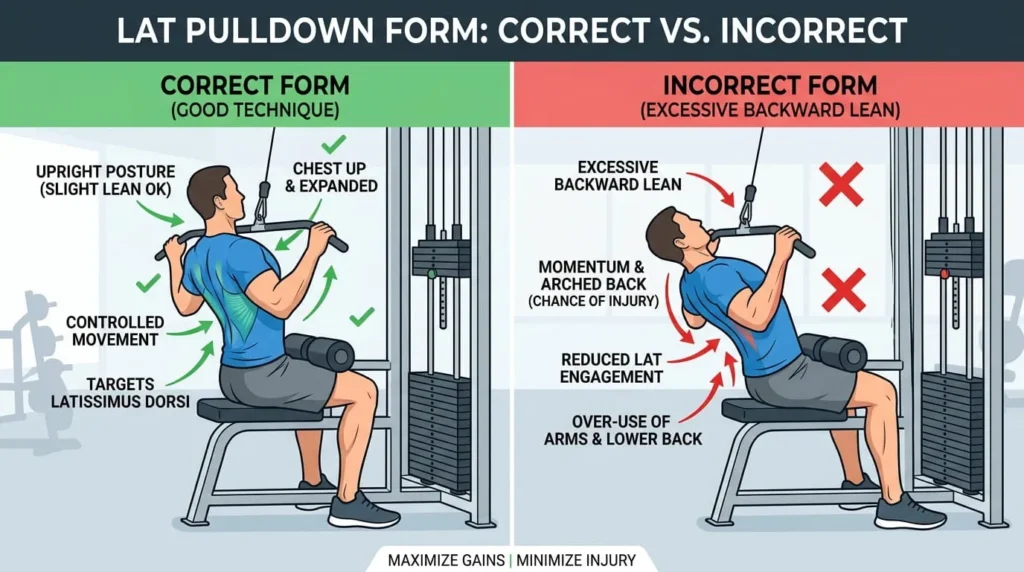
Using momentum instead of controlled tension is also common, especially as fatigue sets in. If you find yourself jerking the bar down or bouncing at the top, the weight is likely too heavy for your current strength level.
Finally, gripping too wide can limit range of motion and shift stress onto the shoulders instead of the lats. A grip just outside shoulder width is usually the most effective starting point.
Lat Pulldown Grip Variations
Wide Grip Pulldown
A wide overhand grip places more emphasis on the outer lats and is the version most people picture when they think of this exercise. It generally allows a slightly shorter range of motion at the shoulder.
Close Grip Pulldown
Using a narrow or neutral grip attachment increases the range of motion at the shoulder joint and tends to bring more of the middle back and biceps into the movement.
Reverse Grip Pulldown
An underhand grip, taken at or just inside shoulder width, shifts additional work onto the biceps while still training the lats effectively. This variation is a useful option for lifters looking to add arm volume without a separate exercise.

Straight Arm Pulldown
Performed with locked or nearly locked elbows, this variation isolates the lats more directly by removing much of the biceps contribution. It works well as a finishing movement after heavier pulling sets.
Lat Pulldown vs Pull-Up
Pull-ups and chin-ups use your full bodyweight as resistance, which makes them harder to scale for beginners. The lat pulldown trains the same basic movement pattern but allows you to select a lighter or heavier load on demand.
This makes the lat pulldown a practical tool for building the strength needed to eventually perform pull-ups, as well as a useful exercise for advanced lifters who want to add extra back volume without the fatigue of another set of bodyweight pulls. Neither exercise fully replaces the other, and many well-rounded back routines include both.
Benefits of the Lat Pulldown
Beyond building a wider, stronger back, the lat pulldown supports better posture by strengthening the muscles that pull your shoulders down and back. This can help counteract the rounded shoulder position common with long hours at a desk.
The exercise also builds pulling strength that carries over to daily tasks like pulling open heavy doors or carrying loads close to the body. Because the resistance is adjustable, it remains useful across a wide range of experience levels, from someone building their first pulling strength to an experienced lifter chasing extra back volume.
How to Add Lat Pulldowns to Your Workout
Lat pulldowns fit naturally into a back day, a pull-focused workout, or a full upper body session. A common approach is 3 sets of 8 to 12 reps, performed after heavier compound pulls like rows or pull-ups if those are included in the same session.
Beginners can start with lighter weight and higher reps, closer to 12 to 15, to build technique before increasing load. As with most cable exercises, controlling the weight through the full range of motion will build more strength over time than simply increasing the number on the stack.


