

Derek Lunsford holds the title of the best bodybuilder in the world as the reigning Mr. Olympia, having reclaimed the Sandow trophy at the 2025 Olympia in Las Vegas after finishing third the year before. He beat a stacked field that included Hadi Choopan, Andrew Jacked, and defending champion Samson Dauda, and his win made him only the second bodybuilder in history, after Jay Cutler, to lose the Olympia title and win it back.
But “best” in bodybuilding is not a fixed label the way a boxing belt is. It shifts every year based on who peaks correctly on one specific weekend, who the judges reward, and which physique trend is currently favored on stage. Understanding who currently holds the title, how that decision gets made, and how the sport’s greatest names compare to each other gives a far more complete picture than a single name ever could.
The Current Mr. Olympia Is the Closest Thing to an Official Answer
Mr. Olympia is bodybuilding’s equivalent of a world championship, and it has been the sport’s most respected benchmark since 1965. Winning it is the closest thing bodybuilding has to an objective, judged answer to who is best in a given year.
Derek Lunsford’s 2025 win capped a season in which he also won the Arnold Classic and the Pittsburgh Pro, completing what competitors call the triple crown. Pulling off all three wins in a single season is rare. Brandon Curry was the last man to combine an Arnold Classic and Olympia win, back in 2019, and few bodybuilders manage that level of consistency across an entire competitive year.
Hadi Choopan finished second for the third consecutive year, a run that has made him one of the most durable runner-ups the sport has seen recently. Andrew Jacked took third after a year widely regarded as his biggest improvement yet, and Samson Dauda, last year’s champion, dropped to fourth.
1. Why the Title Changes Hands So Often
Unlike sports decided by a scoreboard, bodybuilding is judged subjectively against a shifting standard called conditioning, which refers to how dry, vascular, and defined a competitor’s muscle appears on a specific day. A bodybuilder can be objectively bigger than a rival and still lose if his conditioning is slightly off during prejudging. That single-day nature of the sport is why the “best bodybuilder” title rotates more than fans of other sports might expect, and why a champion one year can slip to third or fourth the next.
How Judges Actually Decide Who Is Best
Judges score competitors across mandatory poses and a posing routine, evaluating several factors at once rather than a single measurement like size.
Muscle mass and symmetry matter, but only in balance with each other. A physique with huge arms and underdeveloped legs scores worse than a smaller but proportionate one. Conditioning, meaning visible muscle separation and low body fat without looking depleted, often decides close placings. Stage presence, meaning how confidently and cleanly a competitor transitions between poses, also factors in, since two similar physiques can be scored differently based on presentation alone.
This scoring system is also why online debates about “who’s the best” rarely settle anything. Fans often weigh raw size more heavily than judges do, while judges are trained to prioritize the total package. A competitor can look more impressive in an Instagram photo and still lose on stage because a slightly leaner, more symmetrical rival edges him out under the judging criteria that actually count.
The Divisions Split “Best” Into Different Categories
Modern bodybuilding no longer has one single best. The sport now runs 11 professional divisions at the Olympia, each with its own physique standard, and comparing a winner in one division to a winner in another is largely apples to oranges.
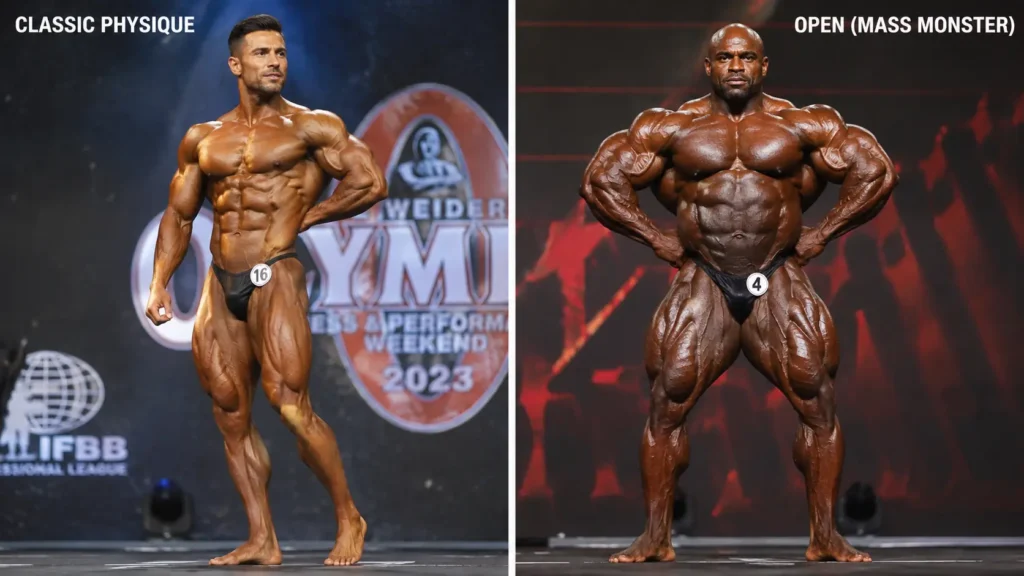
Men’s Open is the category most people mean when they ask who the best bodybuilder in the world is. It has no upper weight limit and rewards maximum muscle mass combined with conditioning, which is why Open competitors are the biggest, most muscular athletes on the roster.
Classic Physique targets a leaner, more aesthetic look modeled on the golden era of bodybuilding from the 1970s. Competitors in this class are held to strict height and weight ratios, which keeps the division from becoming a smaller version of Men’s Open.
Men’s Physique rewards a beach-ready look with visible abs and shoulder-to-waist taper, judged in board shorts rather than posing trunks, without the same mass demands as Open or Classic.
212 Olympia is for competitors under a weight cap, allowing smaller athletes to compete for a title without facing bodybuilders who outweigh them by 50 pounds or more.
Because each division has its own separate winner, a single “best bodybuilder in the world” answer usually refers specifically to the Men’s Open Mr. Olympia champion, since that division still carries the most prestige and the largest prize purse in the sport.
How Today’s Champions Compare to Bodybuilding’s Legends
Ranking the current best against past greats is one of the sport’s oldest arguments, and it usually depends on which era’s standards a person values most.
Ronnie Coleman and Lee Haney share the record for the most Mr. Olympia wins, with eight titles each. Haney dominated from 1984 to 1991 and set the modern template for combining size with symmetry, winning nearly every contest he entered during that stretch. Coleman then redefined what size on stage could look like from 1998 to 2005, bringing a level of mass and conditioning together that no one before him had managed, and he remains the standard many fans still compare current Open competitors against.
Arnold Schwarzenegger won seven Olympia titles in the 1970s and did more than anyone to bring bodybuilding into mainstream culture, though by today’s mass standards his physique would be considered small for the Open division. That gap illustrates how much the sport’s physical benchmark has shifted over 50 years, which is part of why cross-era comparisons rarely produce a clean answer.
Jay Cutler is the only other bodybuilder besides Lunsford to lose the Olympia title and later win it back, a feat that took him years of retooling his physique after his first loss. That history is part of why Lunsford’s 2025 comeback carries extra weight among fans who know the sport’s history, since so few competitors have managed the same turnaround.
1. Why Size Alone Has Never Been the Deciding Factor
A common misconception is that the biggest bodybuilder automatically wins. History says otherwise. Several of the largest competitors in Olympia history, including Big Ramy during parts of his run, lost to smaller but better-conditioned rivals because judges consistently prioritize the complete package over raw mass. Anyone trying to predict a future winner based on offseason photos alone is usually missing half the equation, since a competitor’s on-stage conditioning changes everything about how his size actually reads under the lights.
What It Actually Takes to Compete at This Level
Reaching Mr. Olympia level requires years of structured training, precise nutrition, and a level of recovery management that goes far beyond a typical gym routine.
Most Open competitors train six days a week using a body part split, hitting each muscle group with heavy compound lifts followed by isolation work to bring up specific weak points. Training volume alone is not what separates elite competitors from advanced amateurs. It is the ability to manage that volume for years without accumulating injuries that end a career early.
Nutrition cycles are equally demanding. Competitors move through offseason phases focused on building mass with a caloric surplus, followed by contest prep phases that can last 16 to 20 weeks, gradually cutting calories and carbohydrates to reach the extreme leanness judges expect on stage. Getting this timing wrong, either by dieting too early or too late, is one of the most common reasons a competitor shows up underprepared on Olympia weekend.
Recovery, often overlooked by fans focused only on training footage, plays just as large a role. Elite competitors sleep 8 to 10 hours a night, manage stress carefully, and build deload periods into their training to avoid the joint and connective tissue damage that shortens so many promising careers.
What to Watch For Next Season
Derek Lunsford enters the next competitive year as the man to beat, but Hadi Choopan’s three consecutive runner-up finishes suggest he is not going away, and Andrew Jacked’s rapid improvement over the past year makes him a serious threat if that trajectory continues. Samson Dauda, still only one year removed from his own Olympia win, remains capable of reclaiming the title if his conditioning comes in sharper.
That unpredictability is part of what keeps bodybuilding compelling. The best bodybuilder in the world is not a permanent crown handed to one athlete for life. It is a title that gets defended and re-earned every single year, on one stage, under lighting that leaves nowhere to hide.

