
The clamshell exercise is a side-lying move where you keep your feet together and lift your top knee, like a clam opening. It targets the gluteus medius, a muscle on the outer side of your pelvis that keeps your hips level when you walk, run, or stand on one leg. Physical therapists use it often for hip and knee rehab, and it takes about two minutes to learn.
It is also less powerful than many fitness articles suggest. The lab research is mixed, and the version most people do at home is often done in a way that shifts the work away from the glutes.
This guide covers the exact form, the muscles involved, what the studies found, common mistakes, and how to progress once the basic version feels easy.
How to Do the Clamshell Exercise Step by Step
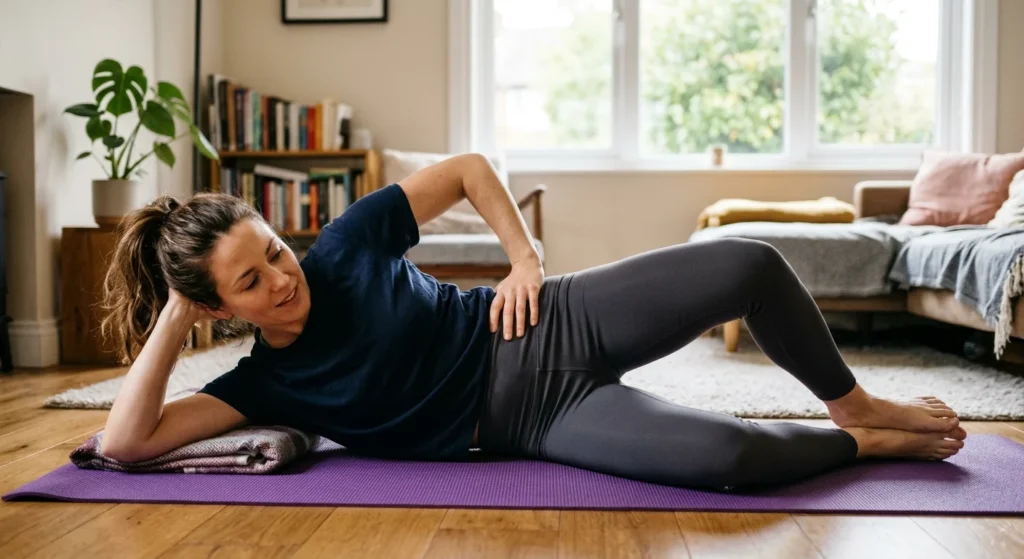
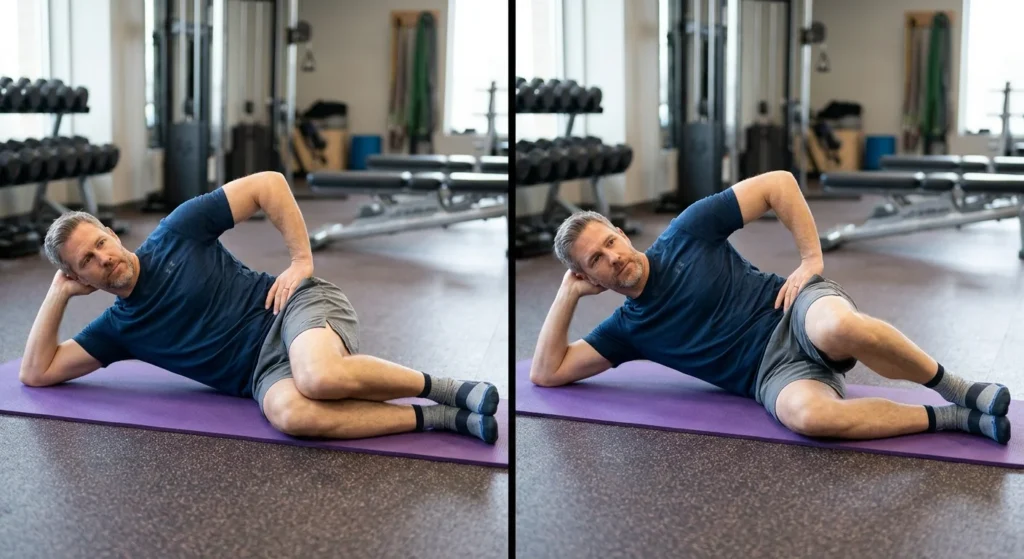
Lie on your side with your hips and knees bent to roughly 45 degrees. Stack your feet, rest your head on your bottom arm, and line up your hips directly over each other so the top hip does not roll backward.
- Place your top hand on your hip so you can feel whether your pelvis moves.
- Lightly tighten your lower belly to hold the pelvis still.
- Raise your top knee toward the ceiling while your heels stay touching. Stop the moment your pelvis starts to tip back.
- Pause for one second at the top.
- Lower the knee slowly over about three seconds.
- Complete 10 to 15 repetitions, then switch sides.
Most people feel the effort in the outer upper buttock, not in the thigh. If the burn shows up at the front of the hip or the outer thigh, your range is probably too big, or your pelvis is rolling.
Muscles Worked by the Clamshell Exercise
The clamshell exercise mainly trains the gluteus medius, with help from the gluteus maximus and the small deep rotators that turn the thigh outward. The gluteus medius stops your pelvis from dropping when you stand on one leg. When it is weak, the knee often drifts inward during running, stairs, and squats.
Two nearby muscles tend to steal the work. One is the tensor fasciae latae (TFL) at the front and outer hip, and the other is the group of anterior hip flexors. Much of the debate about this exercise comes down to how much effort those two absorb.
What the Research Says About Clamshells
Studies That Support the Move
A 2011 study in the International Journal of Sports Physical Therapy measured muscle activity in 24 healthy adults across 18 exercises. A clamshell progression produced about 71% of maximum voluntary isometric contraction (MVIC) in the gluteus medius, which placed it among the top five exercises tested. Side plank abduction with the dominant leg on the bottom ranked first at 103% MVIC.
A 2014 Clinical Biomechanics study by Sidorkewicz and colleagues compared the clamshell with side-lying hip abduction in 13 healthy men. Both stayed gluteus medius dominant, but the ratio of gluteus medius to TFL activity was far greater for the clamshell. Changing the hip flexion angle did not significantly change that ratio.
Researchers at Yonsei University in South Korea also tested modified clamshells on 11 people with a weak gluteus medius. They concluded a modified version could keep gluteus medius activity up while reducing anterior hip flexor activity.
Studies That Question It
A controlled laboratory study in the Journal of Athletic Training reached a different result. Side-lying hip abduction was the best of three exercises for activating the gluteus medius with little TFL and hip flexor involvement. The clamshell produced the most anterior hip flexor activity and little gluteus medius or gluteus maximus activity.
Runner’s World also reported on a study in which clamshells were not very effective at activating any part of the gluteus medius.
Test positions, hip angles, and whether participants had weakness likely explain the gap. A fair reading is that clamshells work as a low-load activation drill, useful for finding the muscle, but they are a weak strength builder for people who already train.
Who Should Do Clamshells
Clamshells fit best in three situations: early rehab when heavier moves hurt, warm-ups before running or lifting, and as a form drill for anyone who cannot feel their glutes working. Beginners with weak hips usually get more from them than experienced lifters do. Physical therapists often prescribe them for kneecap pain and some types of hip pain, but your plan should come from someone who has examined you.
If you already squat, deadlift, or lunge with real weight, the basic version will likely feel too easy. Use one or two light sets as a warm-up and spend your effort on single-leg work and side planks, which ranked higher in the studies above.
Common Mistakes and Quick Fixes
Most clamshell problems come from chasing height instead of control. These are the errors that show up most.
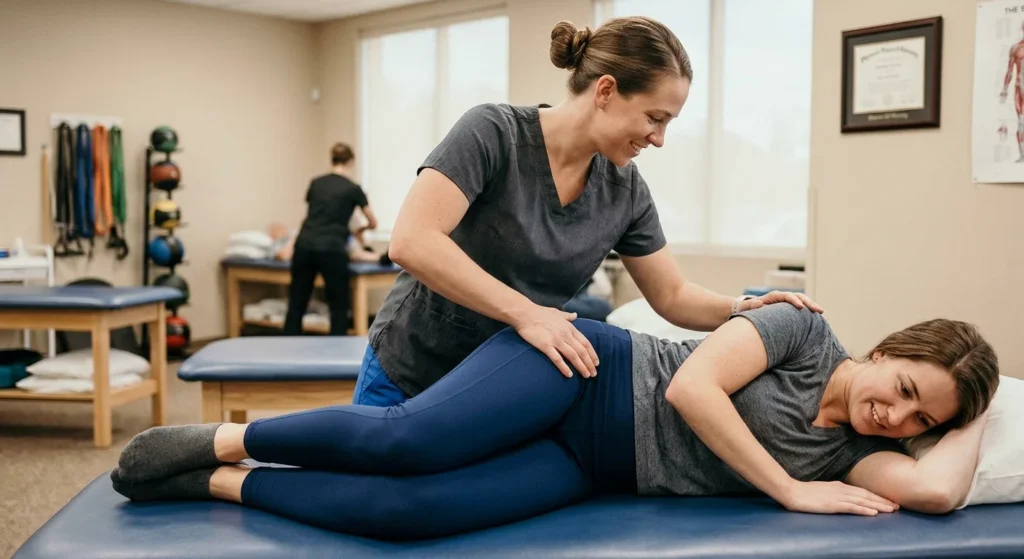
- Rolling the pelvis backward. The knee rises higher, but the work moves to the lower back and hip flexors. Keep your hips stacked, or try a set with your back lightly touching a wall.
- Lifting too far. Move only as far as the pelvis stays still, which is often just a few inches.
- Swinging. Momentum turns the exercise into a bounce. Lift for one second, pause, and lower for three.
- Letting the feet separate. Keep the heels touching the whole time.
- Feeling it in the front of the hip. Reduce the range and slow down. If that does not fix it, ask a physical therapist to check your form.
- Clenching the lower back. A light belly brace is enough.
How to Make Clamshells Harder
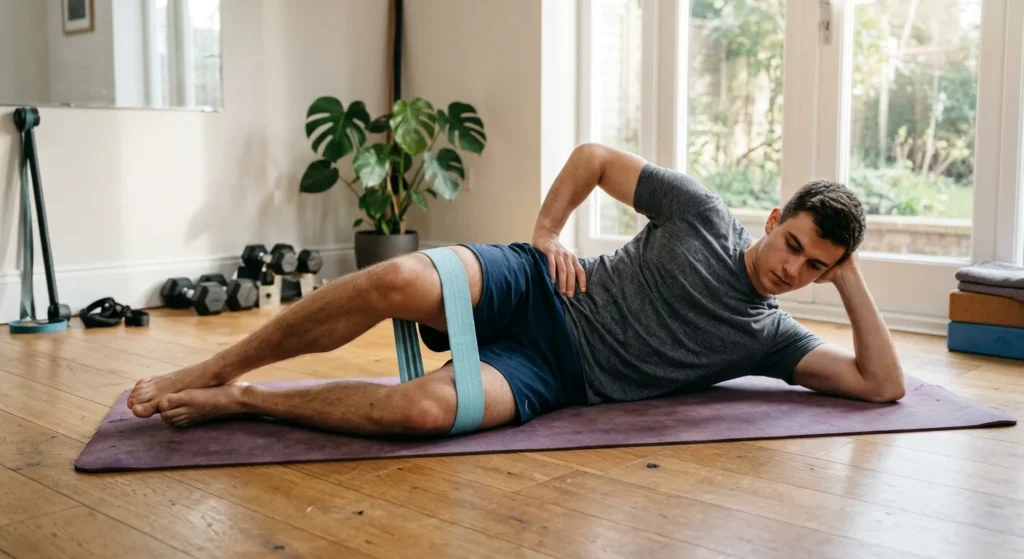
Once 15 slow reps feel easy, add resistance before adding speed. A mini loop band just above the knees is the simplest change, and a lighter band is a good place to start. Placing it above the knee keeps it from sliding down the leg.
You can also try a reverse clamshell, where the knee stays down and the top foot lifts. Another option is holding the top position for five seconds on each rep. Ankle weights work too, but they pull the leg down and often make people compensate.
When bands feel easy, move on to side-lying hip abduction and side planks. Those showed higher gluteus medius activity in the studies above, so they make a better next step than piling on more clamshell sets.
Clamshell vs. Side-Lying Leg Raise vs. Side Plank
These three moves all train the outer hip, but they do different jobs. The clamshell is the gentlest and the best for learning to feel the gluteus medius. The side-lying leg raise asks for more effort and, in the Journal of Athletic Training study, activated the muscle better with less TFL involvement.
The side plank with a leg lift is the hardest. It topped the rankings in the 2011 International Journal of Sports Physical Therapy study, though it is too demanding for many beginners or people in early rehab. A sensible order is clamshell first, side-lying raise second, and side plank work once you can hold the position without your hips sagging.
A Simple Clamshell Routine
This takes about 10 minutes and works as a warm-up or a light standalone session, two to three times per week.
- Banded clamshell: 2 sets of 12 per side, slow lowering
- Side-lying hip abduction: 2 sets of 12 per side
- Knee side plank: 2 holds of 20 to 30 seconds per side
- Glute bridge: 2 sets of 12
Stop each set when your form slips, not when you hit a number. Shorter, cleaner sets build more control than long, sloppy ones.
When to Skip It or See a Professional
This article is general fitness information and not medical advice. Stop and get checked if you feel sharp or pinching pain at the front of the hip, pain that radiates down the leg, or pain that gets worse after exercise. Anyone recovering from hip surgery or a hip replacement should follow the surgeon’s or physical therapist’s protocol and not a general guide.
Persistent knee pain, hip pain, or low back pain deserves a proper assessment. Clamshells may be part of the answer, but a clinician can tell you whether weakness is actually the problem.