


You can build real chest muscle at home with nothing but your own bodyweight, as long as you use the right push-up variations and control your rest periods. The chest responds to tension and volume, not to a specific piece of equipment, so a well-structured bodyweight routine can produce visible growth over eight to twelve weeks.
Why Push-Ups Still Work for Chest Growth
A standard push-up puts the pectoralis major and minor through nearly the same range of motion as a barbell bench press, just with your bodyweight instead of a bar. The main limitation is that a flat push-up caps out around 60 to 70 percent of your one-rep bench equivalent, which is why most people plateau on push-ups after a few months.
The fix is changing the angle and the tempo, not adding a gym membership. Elevating your feet shifts more load onto the upper chest. Slowing the lowering phase to three or four seconds increases time under tension, which is one of the main drivers of muscle growth according to research published in the Journal of Strength and Conditioning Research. Adding pauses at the bottom removes the stretch reflex that lets you bounce out of the rep, forcing the chest to do more of the work.
1. Standard Push-Up Form Check
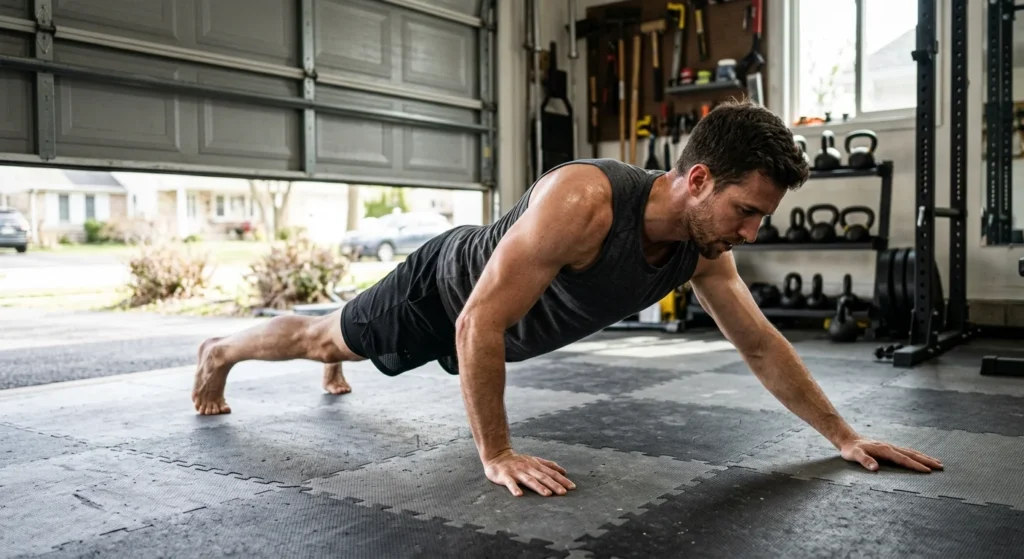
Hands should sit slightly wider than shoulder width, fingers pointing forward. Your body should form a straight line from ankles to shoulders, with no sagging at the hips. Lower until your chest is an inch or two off the floor, then press back up without locking your elbows out hard at the top. Most beginners let their elbows flare out to 90 degrees, which puts unnecessary stress on the shoulder joint. Keep them closer to a 45-degree angle from your torso instead.
The Full At-Home Chest Workout
This routine takes about 25 minutes and only needs a chair or low bench, which most people already have. Do it two to three times a week, with at least one rest day between sessions.
Warm up with two minutes of arm circles and 10 slow bodyweight squats to get blood into the upper body.
Round one:
- Standard push-ups, 3 sets to near failure
- Wide push-ups, 3 sets of 12 to 15
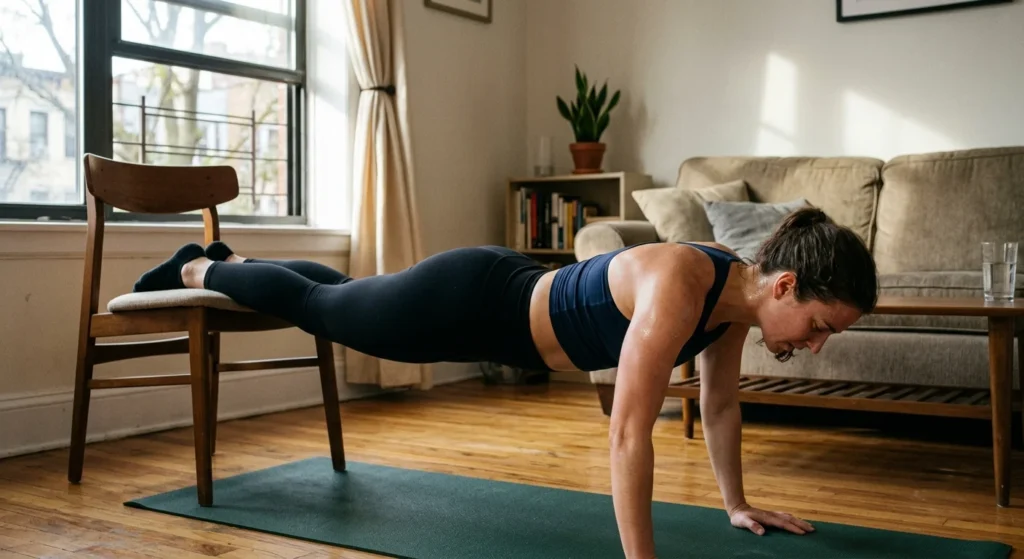
- Decline push-ups with feet on a chair, 3 sets of 10 to 12
Round two:
- Diamond push-ups, 3 sets of 8 to 12
- Pseudo planche push-ups (hands positioned near your hips, leaning forward), 3 sets of 6 to 10
- Chest squeeze push-ups hands close together with elbows tucked, 3 sets of 12
Rest 60 to 90 seconds between sets in round one, and 45 to 60 seconds in round two, since the later exercises are more about squeezing the muscle than moving a heavy load.
How to Make Push-Ups Harder Without Weights
Once standard push-ups feel easy for 20 or more reps, add resistance through mechanics instead of dumbbells. A weighted backpack loaded with books works if you have one, but even without extra load you can increase difficulty through:
Tempo changes. A four-second lowering phase with a two-second pause at the bottom on every rep turns a set of 15 easy push-ups into a set of 10 genuinely hard ones.
Single-arm progressions. Archer push-ups, where you shift most of your weight onto one arm while the other stays extended out to the side, build unilateral strength that a two-arm push-up never will.
Explosive variations. Clap push-ups or plyo push-ups off an elevated surface recruit more fast-twitch fibers, which adds a strength dimension that slow reps don’t cover.
1. Sample Progression Over Six Weeks
Weeks one and two: standard push-ups, wide push-ups, decline push-ups, three sets each, focusing on full range of motion.
Weeks three and four: add diamond push-ups and pseudo planche push-ups; increase the decline push-up angle by using a taller surface.
Weeks five and six: introduce tempo push-ups with a four-second negative, and try one set of archer push-ups per session to build toward single-arm strength.
Common Mistakes That Stall Chest Growth at Home
Rushing through reps is the biggest one. A push-up done in under a second at the top and bottom skips most of the time under tension that actually builds the muscle. Slow down the lowering phase specifically, since that eccentric portion causes more of the microtrauma that leads to growth.
Only doing standard push-ups is another common trap. Sticking to one angle for months means the upper and lower chest fibers never get direct attention, which is why so many people say bodyweight training “stopped working” when really they never changed the stimulus.
Skipping rest days matters more for bodyweight training than people assume, because doing push-ups every single day without recovery time means the muscle never gets the 48 hours it typically needs to repair and grow stronger.
Not tracking reps is a smaller issue but still costs progress. If you don’t know that you did 12 push-ups last Tuesday, you have no way of knowing whether 14 this Tuesday is real progress or just a good day.
What Results to Expect and How Long It Takes
Most people who train chest at home two to three times a week with a structured push-up progression notice visible changes in eight to twelve weeks, mainly more definition in the upper chest and less sag in the lower pec area. Strength gains show up faster, often within three to four weeks, since neural adaptation happens before visible muscle growth.

Genuine size gains comparable to weighted bench pressing are harder to reach with bodyweight training alone once you can already do 25 or more clean push-ups, because you run out of ways to add resistance without external load. At that point, a pair of adjustable dumbbells or resistance bands extends the ceiling significantly, but that is a separate investment rather than a requirement to start.
How to Warm Up Properly Before an At-Home Chest Workout
Cold shoulders and elbows are the main reason people feel joint pain during push-up sessions, not the exercise itself. Spend two minutes on arm circles in both directions, then do 10 slow scapular push-ups, where you only bend and straighten your shoulder blades without bending your elbows. This wakes up the smaller stabilizer muscles around the shoulder joint before they get asked to support your full bodyweight.
A short band pull-apart or towel pull-apart, done for 15 reps, also helps balance the pushing work you are about to do with a pulling motion. Skipping this step is fine occasionally, but doing it consistently before every session is what keeps shoulder discomfort from building up over weeks of training.
Should You Train Chest Every Day or Just a Few Times a Week
Training chest daily with high-effort push-up sets is one of the fastest ways to stall progress rather than speed it up. Muscle tissue needs roughly 48 hours to repair the microtears caused by resistance training, and pushing through that window with more hard sets just adds fatigue on top of a muscle that has not recovered yet.
Two to three sessions a week, spaced with at least one rest day between them, gives the chest enough stimulus to grow while leaving room for recovery. On the days in between, light activity like walking or stretching is fine and will not interfere with recovery, but another hard push-up session will.
How to Combine an At-Home Chest Workout with Other Muscle Groups
Chest and triceps pair naturally in the same session, since most push-up variations already recruit the triceps as a secondary mover. Adding a short triceps finisher, such as close-grip push-ups or bench dips off a chair, takes advantage of muscles that are already warmed up and slightly fatigued from the chest work.
Pairing chest with back on the same day is a common alternative, since it balances the pushing and pulling muscles and avoids the front-of-body dominance that comes from doing chest, shoulders, and triceps too often in the same week. A simple three-day split of chest and triceps, back and biceps, and legs covers the whole body without needing more than a chair and floor space.