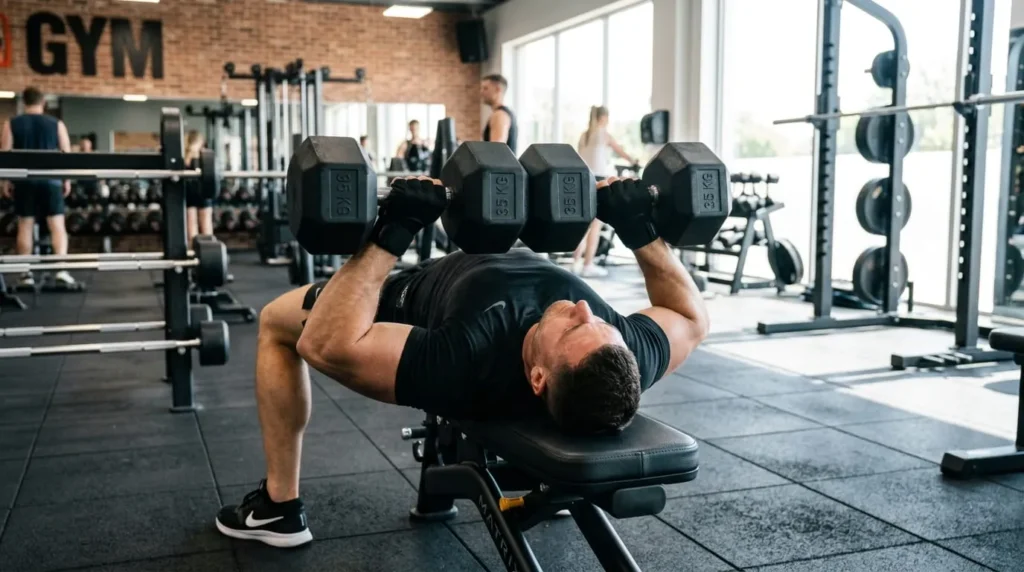

The dumbbell squeeze press is one of the most effective movements for isolating the inner chest and forcing maximal pectoral contraction. Unlike standard pressing exercises where tension peaks at the bottom and drops near lock-out, pressing dumbbells tightly together throughout the entire movement keeps continuous isometric tension on your chest.
Whether your goal is to build upper body mass, target weak points in your bench press lockout, or reduce shoulder strain during chest training, mastering this exercise yields immediate returns. This guide covers exact execution mechanics, key programming variables, common mistakes, and the best variations to include in your workout routine.
What Is the Dumbbell Squeeze Press?
The dumbbell squeeze press, often referred to as the hex press, is a compound chest exercise that combines dynamic pressing with static horizontal adduction. In a conventional dumbbell bench press, the weights move vertically while your hands remain a set distance apart. The movement relies heavily on the triceps and front deltoids to assist the chest at different phases of the lift.
In contrast, the dumbbell squeeze press requires you to crush two dumbbells together as hard as possible throughout the entire range of motion. This constant inward pressure keeps your pectoralis major fully engaged from the starting position to full lockout. Because your hands cannot move inward past the center contact point, the movement eliminates momentum and forces the muscle fibers of your sternal chest to work continuously.
Key Benefits of the Hex Press for Chest Development
Adding the dumbbell squeeze press to your push workouts offers distinct biomechanical advantages that traditional barbell or dumbbell presses cannot replicate.
1: Constant Isometric Tension
Standard free-weight pressing exercises lose tension at the top of the movement when your joints line up vertically over your shoulders. By actively driving two dumbbells inward against each other, you introduce a constant lateral force vector. This ensures your chest muscles remain fully contracted even when your elbows are near full extension.
2: Greater Inner Chest Activation
While you cannot isolate the “inner chest” as a separate muscle anatomical unit, you can maximize tension along the sternal attachment point of the pectoralis major. Horizontal adduction is the primary job of the chest. Aggressively squeezing the dumbbells together accentuates this exact joint action, leading to a deeper muscle pump and better mind-muscle connection.
3: Reduced Shoulder Stress
Standard bench pressing forces your shoulder joints into external rotation and abduction, which can cause impingement or discomfort for lifters with past injuries. The hex press utilizes a neutral grip, with palms facing each other, and keeps your elbows tucked closer to your torso. This position relieves pressure on the rotator cuff and anterior shoulder capsule while maintaining high tension on the chest.
Step-by-Step How to Do the Dumbbell Squeeze Press
Proper execution is critical. Moving heavy weight with poor mechanics turns this targeted chest isolation exercise into an inefficient triceps movement. Follow these steps to maximize chest stimulation.
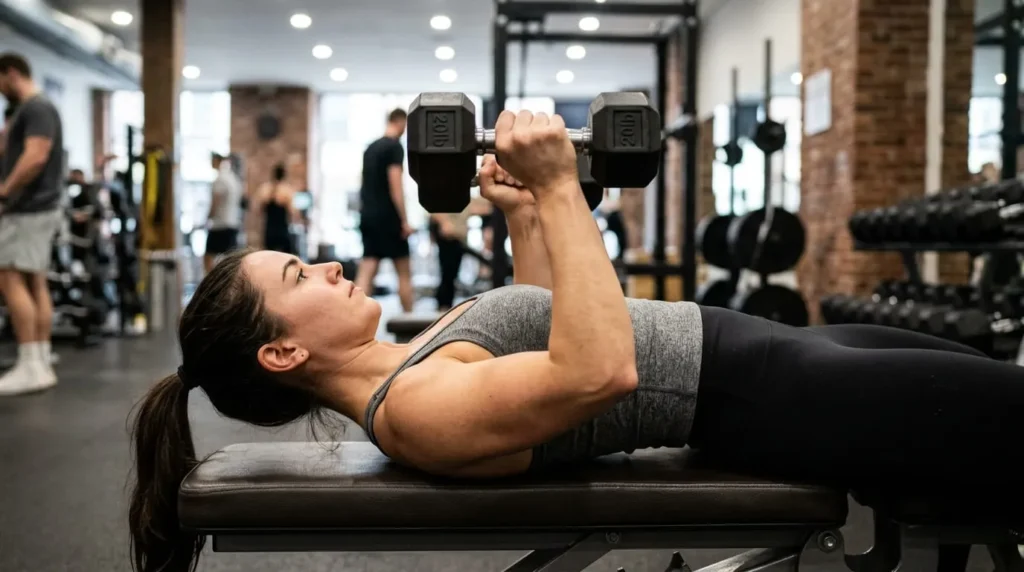
Step 1: The Setup
- Sit on the edge of a flat bench with a pair of dumbbells resting vertically on your thighs. Rubber hex dumbbells work best because their flat sides pressed together create a stable, non-slip surface.
- Kick your knees up one at a time to bring the weights to your chest as you lie back on the bench.
- Plant your feet flat on the floor, pull your shoulder blades down and back into the bench, and maintain a slight natural arch in your lower back.
Step 2: The Initial Squeeze
- Position the dumbbells directly over the center of your chest with a neutral grip, palms facing each other.
- Press the flat faces of the dumbbells firmly together so they form a single unit.
- Apply active inward pressure through your palms. Imagine trying to crush a small object positioned between the two weights. Maintain this inward force throughout the entire set.
Step 3: The Descent
- Inhale deeply into your stomach and brace your core.
- Lower the dumbbells under strict control toward the middle of your sternum, keeping them firmly pressed together.
- Keep your elbows tucked at roughly a 45-degree angle relative to your torso. Do not allow your elbows to flare outward to the sides.
- Lower the weights until they lightly contact your chest. Maintain full inward tension at the bottom of the movement.
Step 4: The Press and Peak Contraction
- Exhale as you press the dumbbells upward along a straight vertical path.
- Drive through your palms while continuing to squeeze the dumbbells together as hard as possible.
- Stop just short of locking out your elbows at the top.
- Hold the peak contraction at the top for one full second, squeezing your chest muscles hard before starting the next rep.
Common Dumbbell Squeeze Press Mistakes to Avoid
Even experienced lifters often make form errors that reduce chest activation or shift tension to unintended muscle groups.
1: Easing the Inward Pressure
The most common mistake is allowing the dumbbells to drift apart slightly or reducing the inward squeeze as the weights get heavy. If you stop pushing the dumbbells together, the exercise becomes a simple close-grip press, shifting the majority of the workload directly onto your triceps. If you cannot maintain maximum inward pressure for your entire set, lower the weight.
2: Flaring Your Elbows Outward
Allowing your elbows to flare out wide to 90 degrees puts unnecessary stress on your shoulder joints and disrupts your leverage. Keep your elbows tucked at a 45-degree angle relative to your sides. This keeps your shoulders in a safe, biomechanically sound position and keeps focus on your pectorals.
3: Flaring the Lower Back
Arching your back excessively shifts the angle of your torso, turning a flat press into a steep decline movement. This reduces upper chest involvement and risks straining your lumbar spine. Keep your glutes firmly on the bench and maintain a stable, natural lumbar arch.
Squeeze Press Variations and Equipment Alternatives
Modifying your equipment or bench angle allows you to target different areas of the chest and adjust the movement to fit your training environment.
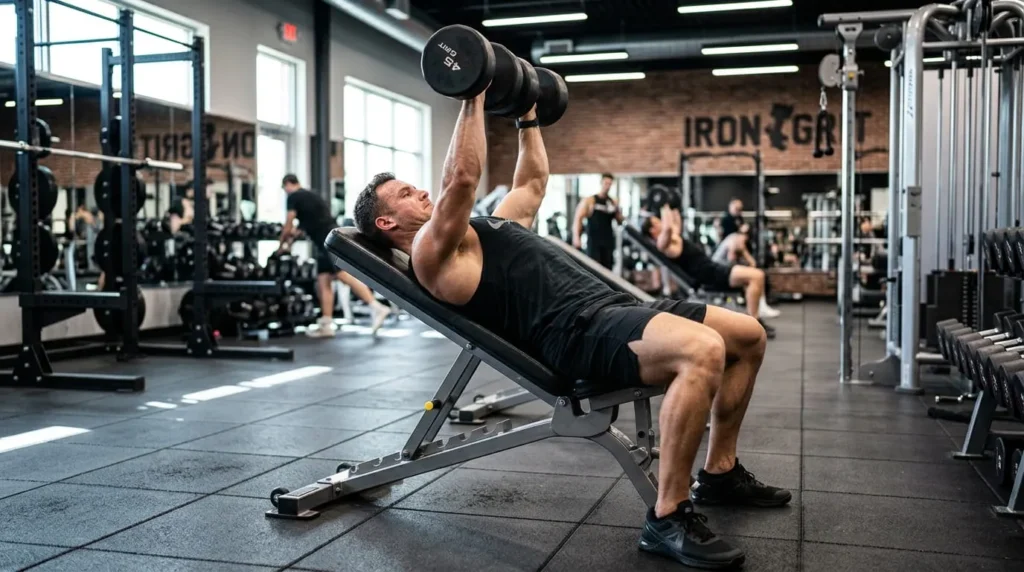
1: Incline Dumbbell Squeeze Press
Adjust an incline bench to 30 degrees. Perform the movement using the exact same technique as the flat version. The angled torso shifts the focal point upward, targeting the clavicular head of the pectoralis major. Avoid setting the bench higher than 30 to 45 degrees, as steeper angles shift the workload away from your chest and onto your front deltoids.
2: Dumbbell Floor Squeeze Press
If you do not have access to an adjustable bench, the floor squeeze press is an effective alternative. Lay flat on the floor with your knees bent and feet flat on the ground. Execute the press normally.
The floor naturally limits your range of motion, stopping your elbows as they touch the ground. This partial range reduces shoulder extension at the bottom, making it an excellent option for lifters managing shoulder discomfort or looking to build lockout power.
2: Svend Press
The Svend press is a standing variation that utilizes a single weight plate instead of dumbbells. Stand upright, hold a weight plate flat between the palms of your hands at chest height, and press the plate straight out in front of you horizontally. While it offers less total loading capacity than dumbbells, it requires continuous chest tension and serves as a strong warm-up or high-repetition finisher.
Comparing the Squeeze Press to Traditional Chest Exercises
Understanding how the squeeze press compares to standard movements helps you select the right exercise for your specific strength and muscle-building goals.
| Feature / Goal | Dumbbell Squeeze Press | Traditional Dumbbell Press | Barbell Bench Press |
| Primary Focus | Inner Sternal Chest | Whole Pectoral Complex | Maximum Load & Power |
| Max Loading Potential | Moderate | High | Very High |
| Isometric Chest Tension | Maximum | Low to Moderate | Low |
| Joint Stress | Low (Neutral Grip) | Moderate | High |
| Technical Difficulty | Moderate | Moderate | High |
Squeeze Press vs. Traditional Dumbbell Bench Press
The traditional dumbbell bench press allows you to lift heavier loads over a slightly wider range of motion, making it superior for overall strength development. However, once you reach full lockout on a standard press, chest tension drops significantly. The squeeze press trades maximal loading capacity for continuous isometric tension, making it better suited for hypertrophy and target muscle isolation.
Squeeze Press vs. Dumbbell Chest Flyes
Dumbbell flyes stretch the chest at the bottom of the movement, but tension drops off completely as your hands reach the top. The squeeze press provides high tension at the top contraction while offering a safer pressing movement pattern that protects the shoulder joints from extreme stretching under load.
How to Program the Dumbbell Squeeze Press
Because the squeeze press relies on conscious isometric pressure rather than maximal resistance, it should not be trained like a primary power movement. Loading too heavy makes it impossible to maintain inward force, turning the exercise into a standard close-grip press.

Recommended Sets, Reps, and Rest Periods
- For Muscle Growth (Hypertrophy): 3 to 4 sets of 8 to 12 reps with 60 to 90 seconds of rest between sets. Focus on a 2-second eccentric phase (lowering) and a 1-second pause at peak contraction.
- For Endurance and Pump Finishers: 2 to 3 sets of 15 to 20 reps using lighter weights. Use these at the end of your chest workout to fully exhaust remaining muscle fibers.
Workout Placement
Place the dumbbell squeeze press second or third in your chest or push routine, directly after your heavy compound movements such as barbell bench presses or heavy incline dumbbell presses. Performing it after your heavy strength work allows you to fatigue your chest fibers using lighter weights without stressing your joints.
It also works exceptionally well as part of a superset. Pair a set of flat dumbbell flyes or standard dumbbell presses immediately with a set of dumbbell squeeze presses to thoroughly burn out the chest.
Equipment Recommendations
Using the right style of dumbbell makes a significant difference in execution.
Adjustable Dumbbells: Block-style adjustable dumbbells work well due to their flat exterior plates. Dial-style round adjustable weights can be used, but take extra care to ensure the locking mechanisms do not interfere with pressing the flat surfaces together.
Hex Dumbbells: Rubber or cast iron hex dumbbells are the ideal choice. Their flat sides lock together seamlessly, creating a stable surface that prevents the weights from slipping or rolling out of alignment while you press them together.
Round Dumbbells: You can use round dumbbells, but they demand significantly more stability to keep the weights from sliding past each other. If using round weights, drop the load slightly to maintain safety and control.