
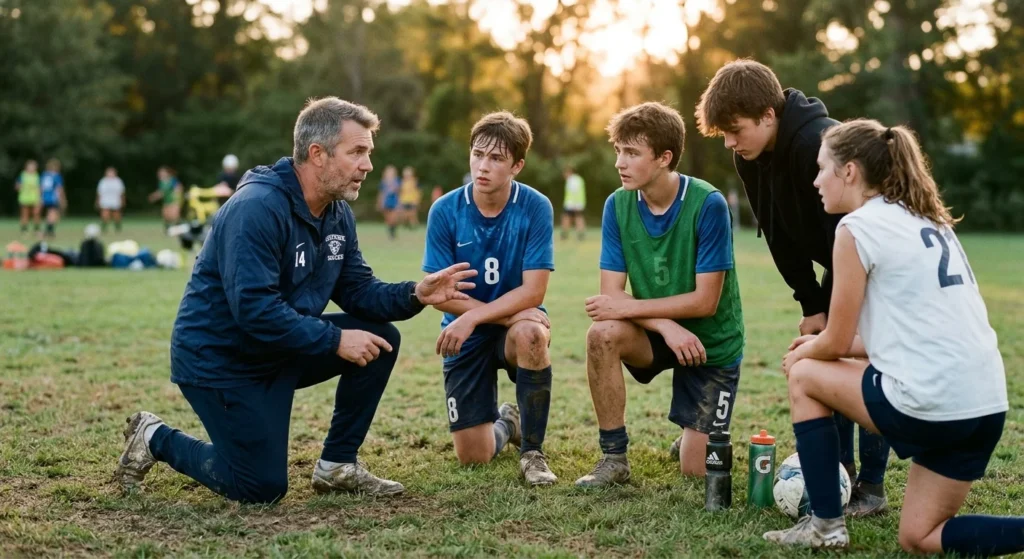

Coaches improve team performance by setting specific goals, building enough trust that players speak up, running practices that look like competition, giving feedback players can act on, and reviewing results on a fixed schedule. None of this needs a bigger budget or better athletes. It needs a plan and the discipline to repeat it every week.
This playbook covers each of those areas with steps you can use in youth leagues, high school programs, college teams, and adult recreational play. It also includes a short weekly review routine that most coaching guides skip.
Define What Better Looks Like Before You Change Anything
Wins and losses are a lagging measure that depends partly on opponents, officials, and luck. Pick two or three behaviors you control instead, such as turnovers per game, first-serve percentage, or how often players finish drills at game speed. Write them down and share them with the team.
A soccer coach might track how often the team wins the ball back within five seconds of losing it. A volleyball coach might grade serve-receive passes on a 0 to 3 scale at every practice. A swim coach might track turn times rather than only race finishes.
Specific targets work better than vague ones. Edwin Locke and Gary Latham’s 2002 review in American Psychologist found that specific, difficult goals produced higher performance than “do your best” instructions.
Build Psychological Safety First
Players who fear getting benched stop reporting minor injuries, stop admitting they missed an assignment, and stop calling out teammates. That silence costs games. Harvard professor Amy Edmondson defined psychological safety in a 1999 Administrative Science Quarterly study as a shared belief that a team is safe for interpersonal risk-taking.
Google’s Project Aristotle, an internal study of 180 teams, later ranked psychological safety as the most important of the five team dynamics it examined. Sports teams differ from office teams, but the mechanism is the same.
You build it with small, repeatable habits. React to the first mistake of practice calmly, because players watch that reaction more than they listen to your speech. Admit your own errors out loud (“I called the wrong play there”), and ask players what they saw before you explain what you saw.
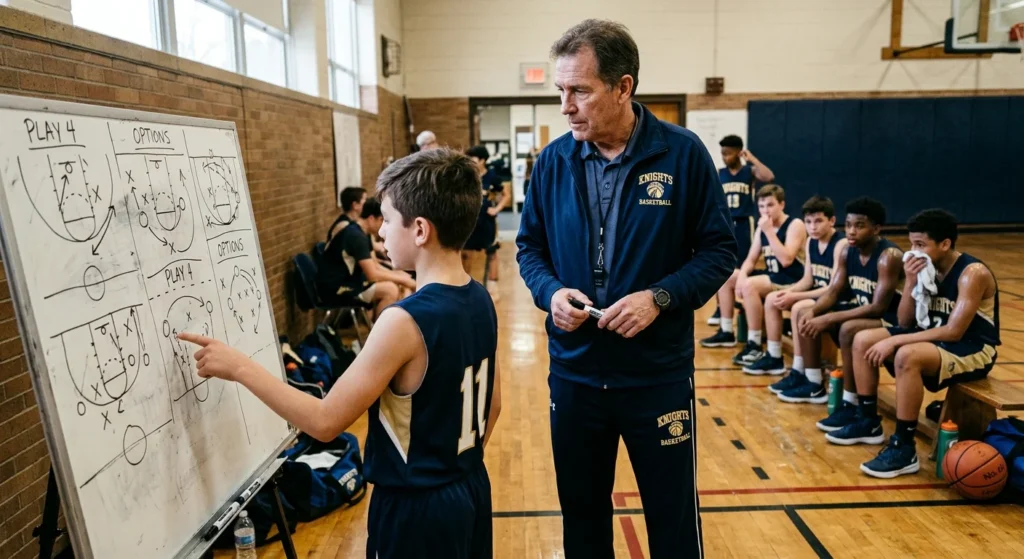
Some coaches give a “best mistake” shoutout at the end of practice for the most aggressive attempt that failed. It tells players that trying hard things is safe.
Give Every Player a Defined Role
Role confusion causes more friction than lack of talent. A player who does not know why she is on the bench, or what the coach expects when she checks in, plays tentatively.
Give every player, starters and reserves alike, a one-sentence role and one measurable job. A basketball reserve might own “defensive energy for the first four minutes.” A baseball utility player might own “be ready at three positions.”
Hold a short one-on-one early in the season. Cover what the role is, how you will judge it, and what would earn a bigger one. Revisit it at midseason, since a role that never changes eventually makes players stop trying.
Run Practices That Look Like the Gam
Anders Ericsson’s 1993 Psychological Review paper on deliberate practice found that top performers work with focused attention on specific weaknesses and get immediate feedback. Long lines, lapping the field, and scrimmages with no teaching point do neither.
Count reps. If twelve players share one drill station, most of your practice time is standing around. Convert it to small-sided games, such as three-on-three in basketball or soccer, where every player touches the ball far more often.
Build in decisions too. Players who only run closed drills struggle once a defender moves. Add a live opponent, a time limit, or a changing score so they read the situation instead of repeating a movement.
John Wooden planned each UCLA practice on index cards, down to the minute. You do not need cards, but a written plan with time blocks and one teaching point per block keeps practice from drifting.
Give Feedback Players Can Use
In a 1976 Psychology Today article, Roland Tharp and Ronald Gallimore charted what Wooden actually said during practice. Most of it was short, specific instruction, and praise and scolding each made up well under 10 percent of his comments.
Good feedback names the action, states the effect, and gives the next rep. “Your front foot opened early, so the ball sailed left. Go again and keep it closed” beats “Focus!” every time. Give one cue at a time, since players cannot apply four.
Fix technique in the moment or at the next break. Save conversations about attitude or effort for a private moment.
Tone matters as much as content. Frank Smith, Ronald Smoll, and John Curtis trained Little League coaches in supportive, instruction-focused habits in a 1979 Journal of Sport Psychology study. About 5 percent of children on those coaches’ teams dropped out the next year, compared with 26 percent on teams with untrained coaches.
Meet Players’ Motivation Needs
Edward Deci and Richard Ryan’s self-determination theory says people stay motivated when three needs are met: autonomy, competence, and relatedness. Geneviève Mageau and Robert Vallerand applied it to sport in a 2003 Journal of Sports Sciences paper, arguing that coaches who support those needs get more sustained effort from athletes.
Autonomy can be small. Let players choose between two drills, run the warm-up, or help write a team rule. Competence comes from progress players can see, such as a chart of free-throw percentage across the season.
Relatedness comes from shared rituals. A team dinner, a pregame routine, or a captain who checks on teammates all count. Controlling language (“you have to,” “you’d better”) works against all three needs, so swap it for reasons (“we do this because”).
Develop Player Leaders Who Share the Load
A coach cannot see everything. Players often hold each other to standards more effectively than an adult can, because peer expectations carry weight a coach’s voice does not.
Choose captains who show good conduct, even when they are not the best player. Meet with them for ten minutes each week. Teach them to give the same kind of feedback you do: specific, immediate, and about the action.
Rotate smaller jobs, such as leading stretches or running a postgame huddle, so more players practice speaking up. Set a team standard early, in the players’ own words, covering effort, punctuality, and how teammates talk to each other. When someone breaks it, the standard becomes the reference point, not your mood that day.
Handle Conflict and Slumps Early
Conflict that gets ignored turns into cliques. Address friction privately and quickly, with both players present if the issue is between them. Ask each to describe the problem in one sentence, then ask what each will do differently.
Slumps call for the opposite of most coaches’ instinct. After three or four bad games, the urge is to add new plays, new drills, and longer film sessions. Cut inputs instead, return to two or three fundamentals the team executes well, and rebuild confidence through wins in practice.
Albert Bandura’s 1977 Psychological Review paper on self-efficacy identified past successes as the strongest source of belief in one’s own ability. Staging small, winnable challenges in practice gives players those successes back.
Run a Fifteen-Minute Weekly Coaching Audit
Most coaches review games and forget to review their own coaching. A short weekly audit fixes that. Schedule it for the same time each week, ideally the day after a game.
Answer four questions in a notebook or shared spreadsheet. What improved since last week, and what is the evidence? Which single behavior cost the team most? What one change will go into the next practice? What did players tell you?
Limit film to three clips of about two minutes each, with at least one positive example. Where you have data, such as GPS vests at the college level or a simple stat sheet in youth sports, track no more than three numbers.
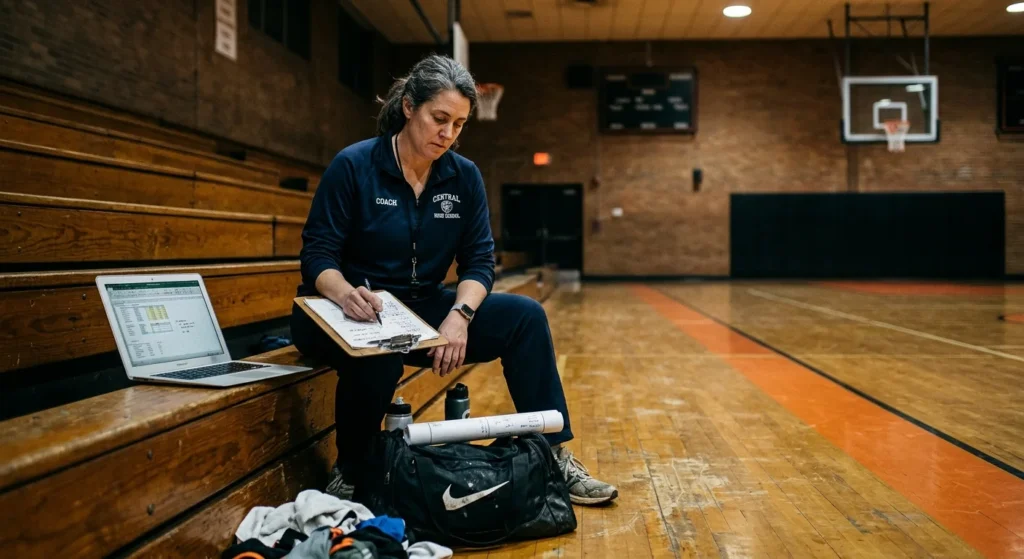
A season of one-page logs shows what actually moved performance. It also stops you from overhauling everything after one bad loss.
Adjust the Approach for Age and Level
The same principles apply at every level, but the emphasis shifts. In youth sports, fun and playing time decide whether kids come back, so keep reps high and instruction short. Many U.S. youth organizations tied to national governing bodies also require SafeSport training, which supports the trust work described above.
High school coaches compete with academics and part-time jobs, so shorter, sharper practices and clear communication about schedules matter. College athletes expect more autonomy and more data. Adult recreational teams care most about relatedness, since they play for community as much as results.
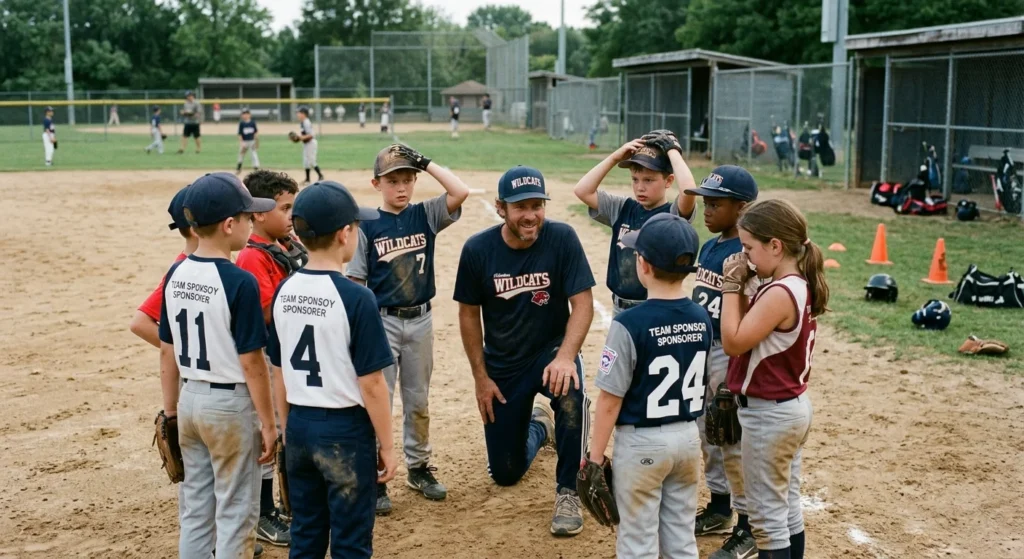
Pick one change from this list and run it for two weeks before adding another.