

A back and triceps workout pairs a pulling muscle group with a pushing one, so you can train hard without either muscle group interfering with the other’s recovery. This guide walks through exercise selection, sets and reps, rest periods, and the form mistakes that quietly stall progress.
Why Train Back and Triceps Together
Back exercises are pulling movements. Triceps exercises are pushing movements at the elbow joint. Because they work in opposite directions, you can go heavy on rows and pulldowns without pre-fatiguing the triceps, then finish with triceps isolation work while your back muscles rest.
This pairing also fits a push-pull training split well. If your week already includes a chest and shoulder day built around pushing, a back and triceps day balances it out and keeps your pulling strength from lagging behind your pressing strength, which is a common issue for lifters who focus mostly on bench press and shoulder work.
Warm Up Before You Load the Bar
Five to ten minutes of light cardio raises your heart rate and loosens the shoulders and elbows before heavy pulling. Follow that with two or three warm-up sets on your first exercise, working up from roughly half your working weight to a set just below it.
Band pull-aparts and scapular retractions are useful additions here. They wake up the mid-back muscles that are easy to underuse when the bigger lats and arms take over a lift.
The Best Back and Triceps Workout
1. Back Exercises
Start with a compound pull that lets you move real weight. Deadlifts, barbell rows, and pull-ups all work the entire back, from the lats down through the erectors, and they build the kind of raw pulling strength that carries over to everyday tasks like carrying groceries or moving furniture.
After the main lift, move to exercises that isolate specific regions of the back. A few reliable choices:
- Barbell or dumbbell rows for the mid-back and lats
- Lat pulldowns or pull-ups for vertical pulling strength
- Seated cable rows for controlled, constant tension
- Single-arm dumbbell rows to correct side-to-side imbalances
- Face pulls for the rear delts and upper back, which also support shoulder health
2. Triceps Exercises
Triceps make up roughly two-thirds of the upper arm’s mass, so they deserve direct attention beyond what pressing movements alone provide. Close-grip bench press is a strong first choice because it still lets you move heavy weight while placing more emphasis on the triceps than a standard bench press does.

Follow it with isolation work:
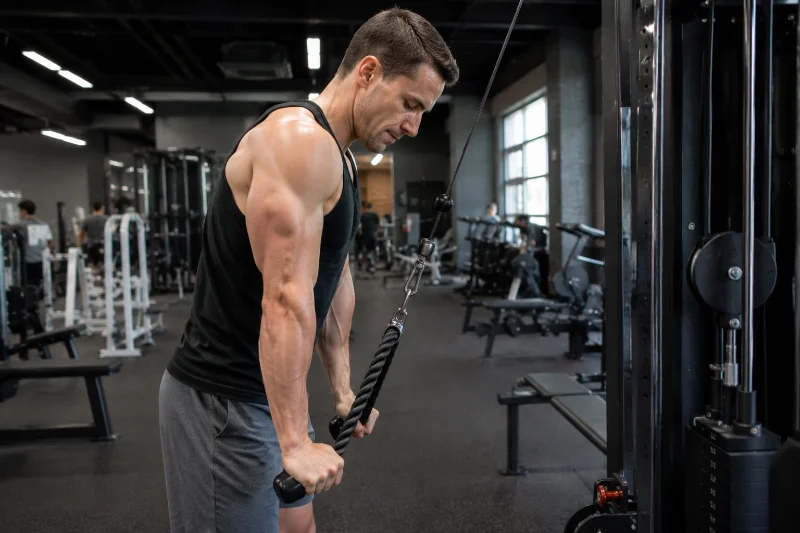
- Triceps pushdowns with a rope or straight bar
- Overhead dumbbell extensions for the long head of the triceps
- Skull crushers with an EZ-bar for controlled elbow extension
- Dips, which also bring the chest and shoulders into play
Sample Back and Triceps Workout Routine
This routine runs about 50 to 60 minutes and works well as a standalone session or as part of a push-pull-legs split.
- Deadlifts or barbell rows, 4 sets of 6 to 8 reps
- Pull-ups or lat pulldowns, 3 sets of 8 to 10 reps
- Seated cable rows, 3 sets of 10 to 12 reps
- Close-grip bench press, 4 sets of 8 to 10 reps
- Triceps pushdowns, 3 sets of 12 to 15 reps
- Overhead dumbbell extensions, 3 sets of 10 to 12 reps
- Face pulls, 2 sets of 15 reps
Sets, Reps, and Rest Periods
Heavier compound lifts like deadlifts and close-grip bench press respond best to lower rep ranges, around 6 to 8 reps, with 2 to 3 minutes of rest between sets so you can recover enough to lift near your working max. Isolation exercises such as pushdowns and extensions work well in the 10 to 15 rep range, with 60 to 90 seconds of rest, since the goal there is muscle fatigue rather than maximum load.
If you are training for strength specifically, the National Strength and Conditioning Association recommends rep ranges of 1 to 6 with longer rest periods for that goal, while ranges of 8 to 12 are more associated with muscle growth. Adjust the routine above depending on which outcome matters more to you right now.
Common Form Mistakes to Avoid
Rounding the lower back during rows and deadlifts is the most common and most costly mistake, since it shifts load away from the target muscles and onto the spine. Keep your chest up and your back flat through the full range of the movement, and reduce the weight if you cannot maintain that position.
Flaring the elbows out during triceps pushdowns and extensions is another frequent issue. Keep your elbows tucked close to your torso throughout the movement so the triceps, not the shoulders, are doing the work.
Using momentum instead of muscle control shows up on both sides of this workout. Swinging the torso on rows or using body English on pushdowns lets you move more weight, but it also removes tension from the muscles you are trying to train, which slows progress even if the number on the plate goes up.
How Often to Train Back and Triceps
Most lifters get solid results training back and triceps once or twice a week, with at least 48 hours between sessions targeting the same muscles. This gives the muscle fibers time to repair and grow stronger before the next session.
If you are newer to lifting, once a week is usually enough while you build a base of strength and technique. More experienced lifters who want faster progress sometimes split the workout further, dedicating one day to back and a separate day to triceps, which allows more total volume for each muscle group across the week.
Track your working weights and reps from session to session. Small, steady increases over weeks and months, rather than large jumps, are what actually build the back and arm strength this workout is designed to deliver.
Equipment You’ll Need
This workout doesn’t require anything exotic, but a few pieces of equipment make it far more effective. A barbell and plates cover deadlifts, barbell rows, and close-grip bench press, while a cable machine handles pulldowns, seated rows, pushdowns, and face pulls. A pull-up bar is useful if you’re substituting bodyweight pulling work for machine-based alternatives. Dumbbells round things out for single-arm rows and overhead extensions. If you’re training at home or in a limited gym, resistance bands can substitute for cables on pushdowns and face pulls without much drop-off in effectiveness.
Nutrition and Recovery Tips
Training back and triceps hard means little if recovery isn’t dialed in. Protein intake in the range of 0.7 to 1 gram per pound of body weight supports muscle repair after a session like this, particularly since the workout hits both a large muscle group and a smaller, more recovery-sensitive one. Sleep matters just as much as food; most of the physical repair that turns training into strength happens during deep sleep, so cutting sleep short undermines the work you just put in. Hydration also plays a quiet role in joint health, especially for the elbows, which take on repeated stress from pushdowns and extensions.