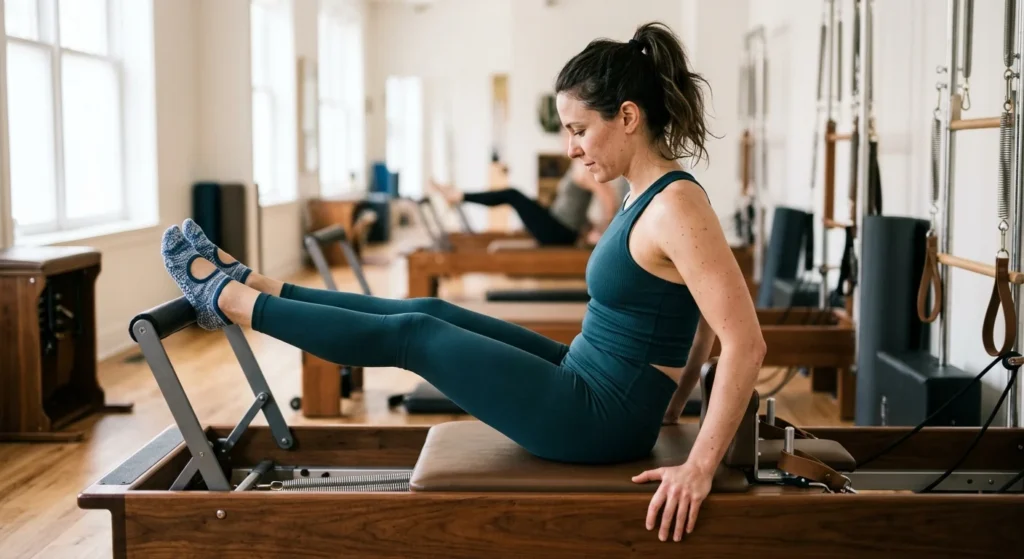

Reformer Pilates is a low-impact strength workout done on a spring-loaded machine with a sliding carriage. You push and pull against adjustable spring resistance while moving through slow, controlled exercises that work the core, hips, back, and legs.
Classes in the US usually run 45 to 55 minutes, and most studios welcome complete beginners. This guide covers how the machine works, what a class feels like, what the research says, and what you can expect to pay.
How a Reformer Machine Works
A reformer looks like a narrow bed frame with a padded platform on wheels. The platform, called the carriage, glides back and forth along rails. Springs attached to one end of the frame pull the carriage back toward its starting position, so every push or pull meets resistance.
You can lie on the carriage, sit on it, kneel, or stand on it, depending on the exercise. Changing your body position changes which muscles do the work.
The Main Parts
Most reformers share the same basic parts:
- The carriage, the padded platform you lie, sit, or stand on
- Springs, which come in different tensions and attach with a hook system
- A footbar at one end for pushing and for hand or foot placement
- Shoulder blocks that keep you from sliding off when you push
- Adjustable straps with handles or loops for arms and legs
- A headrest, usually adjustable, for lying-down work
How Spring Resistance Changes the Exercise
More springs does not always mean a harder workout. A heavy spring setting can make a leg press easier to push, but it can make an exercise that asks you to control the carriage on the way back much harder. Light springs often feel tougher in movements that need balance, because the carriage moves more freely.
This is why instructors change spring loads constantly during a class. The setting is chosen to match the goal of each exercise, not to make everything heavier.
Where Reformer Pilates Came From
Joseph Pilates, a German-born physical trainer, developed the method in the early 20th century. He called it “Contrology” and described it in his 1945 book Return to Life Through Contrology. The story most often told is that he began rigging springs to hospital beds while interned in England during World War I, so bedridden patients could exercise.
He moved to New York in 1926 and opened a studio there, where dancers became some of his first loyal clients. That dance connection is one reason the method is still taught with an emphasis on posture, alignment, and smooth movement. The reformer is one of several apparatus he designed, alongside the Cadillac and the Wunda Chair.
What Happens in a Typical Class
A standard group class starts with a warm-up that wakes up the core and teaches breathing. The instructor then moves you through footwork, which is a series of leg presses against the footbar, followed by exercises for the arms, abdominals, back, and hips.
Movements are slow and deliberate. A single exercise might take eight to ten repetitions, with the instructor cueing small adjustments such as keeping your ribs down or your pelvis still. It feels less like lifting weights and more like holding a position while something tries to move you out of it.
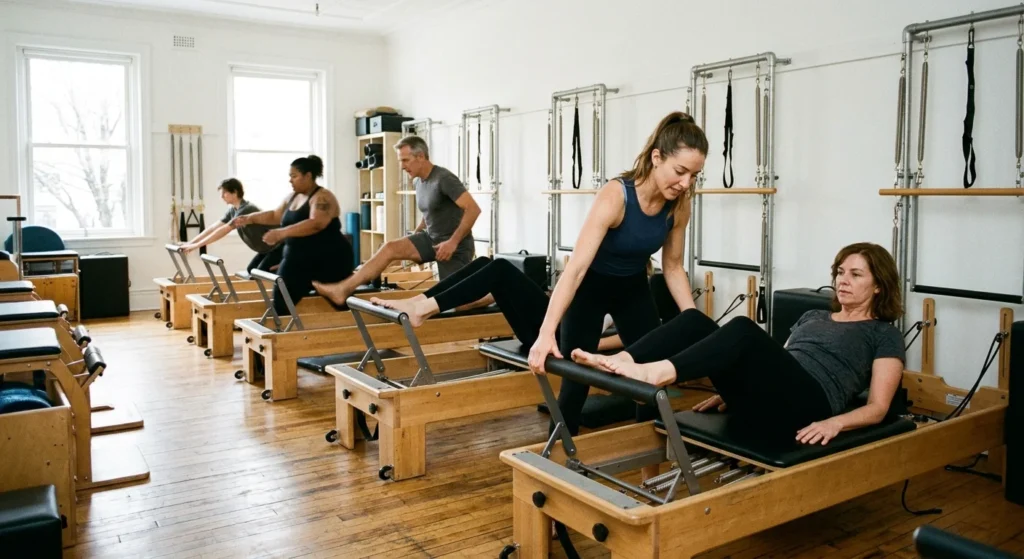
Many people are surprised by how hard it is at the start. A shaking thigh or sore abdominals the next day are common after a first class, even for people who work out regularly.
Common Exercises You Will See
Footwork, the hundred, leg circles in straps, and rowing movements show up in nearly every class. Planks and kneeling arm work add balance and shoulder control. Side-lying leg work targets the outer hips and glutes.
Some studios add a jump board, a platform that attaches to the carriage so you can do low-impact jumping. Others use light hand weights or a spring-loaded tower. Class names vary by studio, so ask what a “beginner” or “foundations” class includes.
What the Research Says About Benefits
People take reformer classes for strength, posture, flexibility, and back comfort. The strongest evidence is for lower back pain. A 2015 Cochrane review led by Yamato and colleagues found that Pilates probably gives better pain relief than minimal intervention for people with chronic low back pain, though the evidence quality was low to moderate.
Most research has studied Pilates broadly, and not every study separates mat work from machine work. So the honest answer is that reformer sessions fit well within the evidence for Pilates, but few trials prove the machine does something mats cannot. Claims that it “tones” or “lengthens” muscles are marketing language, not measured outcomes.
Where it clearly helps is as one part of a weekly routine. The CDC recommends that adults get at least 150 minutes of moderate aerobic activity a week plus muscle-strengthening work on two or more days. A reformer class can count toward the strengthening side, but it does not replace walking, cycling, or other cardio.
Why Beginners Often Feel Results Quickly
The springs support part of your body weight in many positions. That makes it easier for newer exercisers to practice good form than they could with a floor exercise. Instructors also give constant feedback, which speeds up learning.
Balance and body awareness tend to improve first. Strength changes usually take longer to notice and depend on how often you attend, so two classes a week for a couple of months is a realistic starting point.
Reformer Pilates vs. Mat Pilates
Mat Pilates uses only your body weight and a floor mat. Reformer work adds spring resistance and straps, which lets instructors both assist and challenge a movement. Mat classes are cheaper, and you can do them at home with no equipment.
The reformer is often easier to learn on, since springs and straps can support you. It is also easier to scale up, because you can add springs, slow the tempo, or move to harder positions. Mat work can feel harder at first for beginners because there is nothing helping you control the movement.
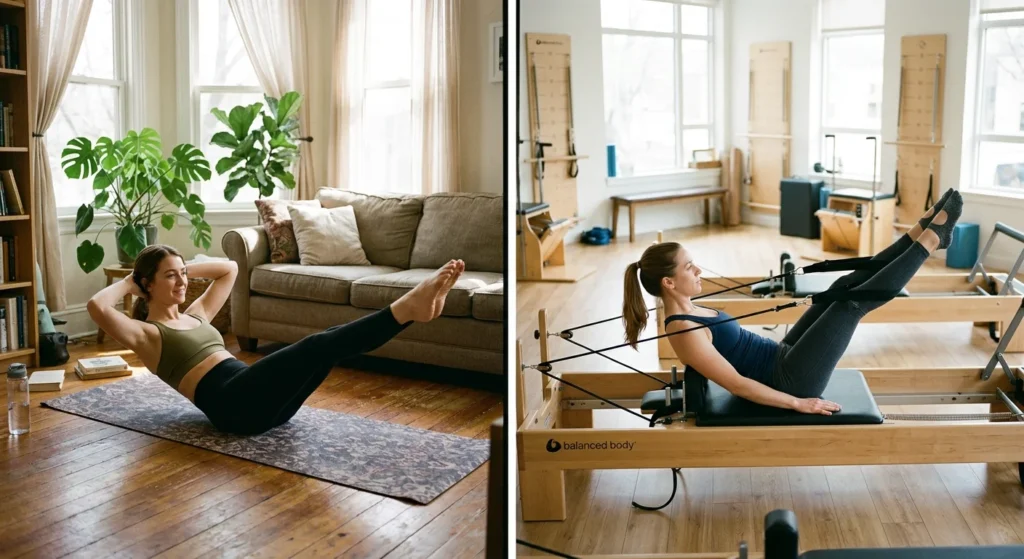
Neither is better for everyone. If budget or schedule is tight, mat Pilates is a fine way to build the same movement habits.
Who Should Be Careful
Talk to a doctor or physical therapist before starting if you are pregnant, recovering from surgery, or managing a back, neck, or joint injury. People with osteoporosis are often advised to avoid deep forward spinal bending, and some reformer exercises involve it. A qualified instructor can change or skip those movements, but they need to know about your situation before class.
Tell the instructor at the start about anything that hurts, including old injuries. Look for instructors certified through a recognized program, such as the Pilates Method Alliance certification pathway or comprehensive training from established schools. Private sessions are a good option if you have a specific condition.
This article is general information, not medical advice. Anyone publishing it on a health-related site should have it reviewed by a qualified fitness or medical professional.
What Reformer Pilates Costs in the US
Pricing varies widely by city and studio type. In many US metro areas, a single group class commonly falls in the range of about $25 to $40, with packs and memberships lowering the per-class price. Private sessions are usually higher, often $80 to $120 or more.
A home reformer can run from a few hundred dollars for a compact folding model to several thousand for a studio-grade machine from brands such as Balanced Body or Merrithew. Many beginners try a few studio classes first, since technique matters and a home machine is a big purchase. Prices change often, so check current rates with local studios and manufacturers.
What to Wear and Bring to Your First Class
Wear fitted, stretchy clothes so the instructor can see your alignment. Baggy pants can catch on springs and straps. Most studios require grip socks, which have rubber dots on the sole, and many sell them at the front desk.
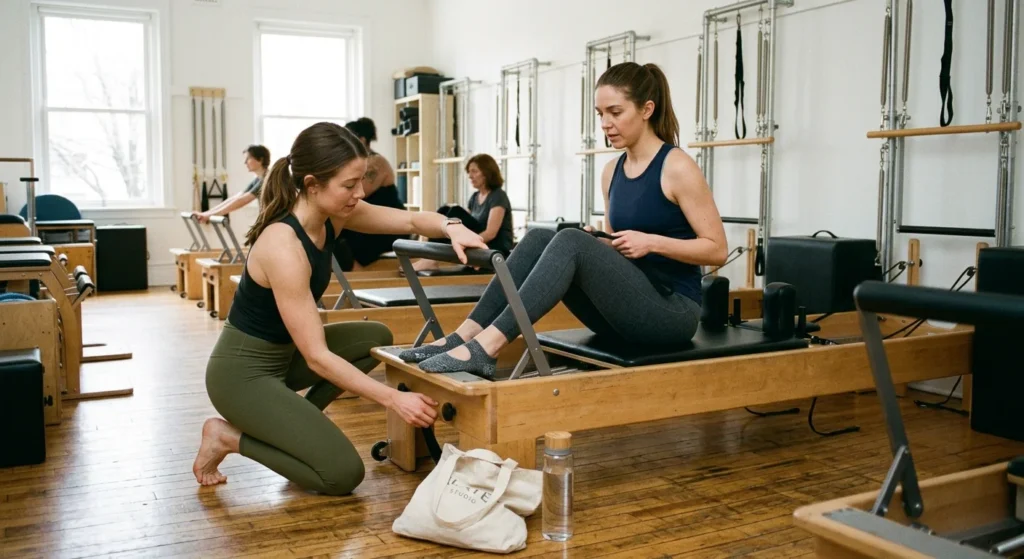
Arrive 10 to 15 minutes early. Tell the instructor it is your first time, so they can set your springs and walk you through the machine before class begins. Bring water, and skip a heavy meal in the hour beforehand, since many exercises compress the abdomen.
Tips for Getting the Most From Your First Few Weeks
Take a foundations or beginner class for at least the first four to six sessions. Stay in the same studio long enough to learn the names of the parts and the basic exercises, because the vocabulary repeats. Pick a consistent time of week, so it becomes a habit.
Move slowly and ask questions. If an exercise feels wrong in your joints, as opposed to the muscle effort you expect, stop and tell the instructor. Understanding what reformer Pilates is really comes down to learning that control matters more than speed or range.