


If you only have 20 minutes and one kettlebell, you can still get a full-body workout that builds strength, burns fat, and improves conditioning. This 20 minute kettlebell workout is built for beginners who want real results without spending an hour in the gym. It uses five basic movements, a simple circuit format, and one kettlebell, so there is no equipment guesswork and no wasted time.
Kettlebell training earned its reputation because it combines strength work and cardio in the same movement. A single swing trains your hips, grip, shoulders, and core at once. That efficiency is exactly why a short kettlebell circuit can outperform a much longer session on a machine.
Why a 20 Minute Kettlebell Workout Works So Well
Most beginners assume a short workout cannot be effective. With kettlebells, the opposite is usually true. Kettlebell exercises are compound movements, meaning they recruit multiple muscle groups at the same time instead of isolating one joint. A goblet squat works your quads, glutes, core, and upper back simultaneously. That is very different from a leg extension machine, which only moves your knee.
Because kettlebell movements are dynamic, they also raise your heart rate faster than traditional weightlifting. A 20 minute kettlebell workout structured as a circuit keeps rest periods short, so you get strength training and cardiovascular work in the same session. This is the main reason kettlebell circuits show up so often in beginner fitness plans instead of longer, split-style routines.
There is also a practical reason this format works for beginners specifically. Learning five kettlebell exercises well is far more useful than learning fifteen poorly. A short, repeatable circuit lets you build real technique before adding weight or complexity, which lowers injury risk and speeds up progress.
What You Need Before You Start
One of the biggest advantages of this style of training is how little equipment it requires. Single kettlebell workouts are popular precisely because you do not need a rack of dumbbells or a full gym to get a real training effect.
1. Choosing the Right Kettlebell Weight
For a beginner kettlebell workout, weight selection matters more than most people expect. Too light and you will not challenge your muscles. Too heavy and your form breaks down, especially on the swing and the clean.
As a general starting point, women new to kettlebell training often begin with 8 to 12 kilograms, while men often start with 12 to 16 kilograms. These are starting ranges, not fixed rules. If you already strength train regularly, you may comfortably start higher. If today’s workout is your first time picking up a kettlebell, it is smarter to start lighter and focus on movement quality first.
A simple test works well here. If you can complete 10 controlled reps of a goblet squat with good form and still have two or three reps left in the tank, your weight is close to right. If your form falls apart before rep 8, drop the weight.
2. Space and Surface
You need enough room to swing a kettlebell without hitting furniture, walls, or another person. A flat, non-slip surface is important since kettlebell moves involve fast hip movement. Rubber gym flooring, an outdoor patio, or a carpeted room all work well. Avoid slick hardwood or tile unless you place a mat down first.
Warm Up Before You Start the Circuit
Skipping a warm up is one of the fastest ways to get hurt with kettlebells, since several exercises rely on hip hinge mechanics that need mobile hips and a warm lower back. Spend three to five minutes on the following before starting the main circuit.
Start with 10 bodyweight squats to wake up your hips and knees. Follow with 10 arm circles in each direction to loosen your shoulders. Add 10 hip hinges without weight, focusing on pushing your hips back rather than bending your knees. Finish with 20 to 30 seconds of light jogging in place to raise your heart rate slightly before the circuit begins.
The 20 Minute Kettlebell Workout Circuit
This kettlebell circuit uses five exercises performed back to back with minimal rest. Complete all five moves, rest for one minute, then repeat the full circuit three more times. Each round takes roughly four minutes, which brings the total session to about 20 minutes including transitions.
1. Kettlebell Goblet Squat, 12 reps
Hold the kettlebell close to your chest with both hands cupping the horns. Keep your chest up and push your hips back as you squat, letting your elbows brush the inside of your knees at the bottom. Drive through your heels to stand back up. This move builds leg and core strength while teaching proper squat depth.
2. Kettlebell Swing, 15 reps
The swing is the signature kettlebell movement and the engine behind most kettlebell circuits. Stand with feet shoulder width apart, hinge at the hips, and let the kettlebell swing between your legs. Snap your hips forward to drive the kettlebell up to chest height, keeping your arms relaxed. The power comes from your hips, not your shoulders. This single exercise trains your glutes, hamstrings, core, and grip at once.
3. Kettlebell Row, 10 reps per side
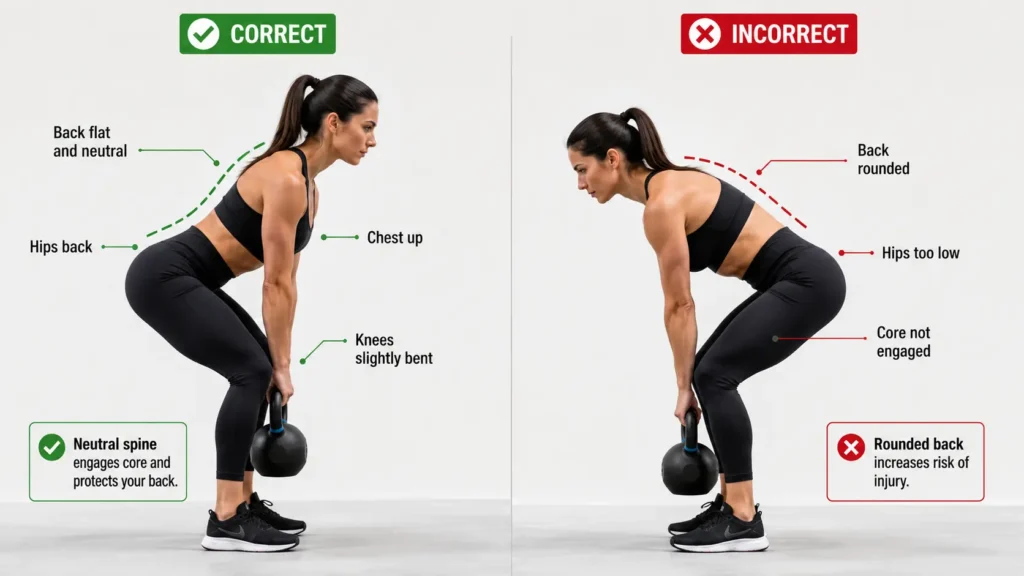
Hinge forward at the hips with a flat back, letting the kettlebell hang from one hand. Pull the kettlebell up toward your ribs, squeezing your shoulder blade at the top, then lower under control. This balances out all the pushing and squatting elsewhere in the circuit and strengthens your upper back.
4. Kettlebell Deadlift, 12 reps
Stand over the kettlebell with feet hip width apart. Hinge down, grip the handle, and stand up by driving your hips forward, keeping the kettlebell close to your shins the entire way. This is often the safest entry point into kettlebell training for complete beginners since it removes the swinging component while still teaching the hip hinge.
5. Kettlebell Halo, 10 reps
Hold the kettlebell upside down by the horns at chest height and circle it around your head, keeping your core braced so your torso does not twist. Reverse direction after five reps. This move improves shoulder mobility and core stability, which carries over into every other exercise in the circuit.
Beginner Kettlebell Workout Modifications
Not every beginner starts at the same level, and this kettlebell workout for beginners can flex to match your current fitness.
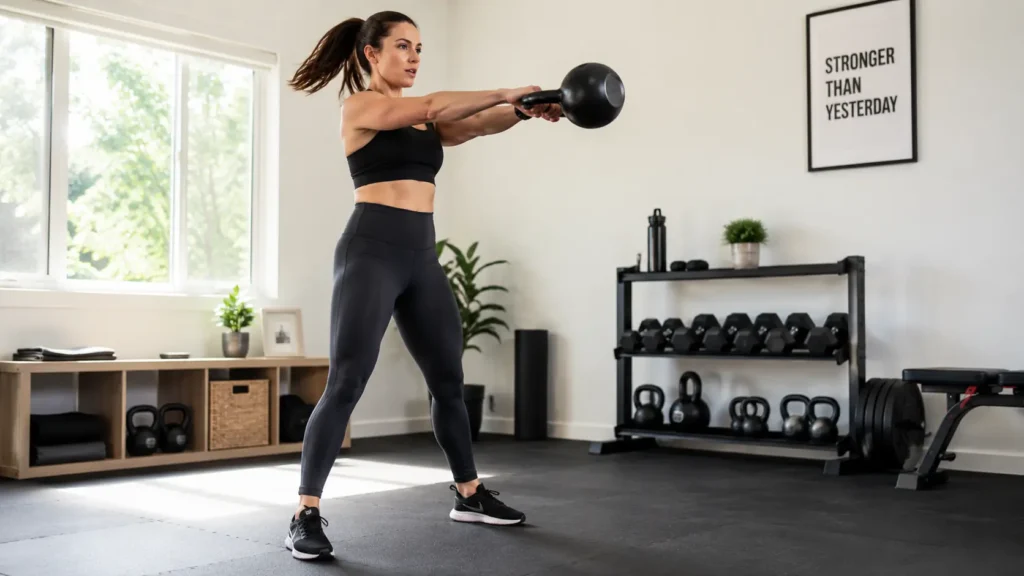
If the swing feels too advanced on day one, replace it with an extra set of deadlifts until your hip hinge pattern feels natural. Swapping in a hinge-only movement removes the ballistic timing challenge while still training the same muscles.
If 12 reps of goblet squats feels too demanding early on, drop to 8 reps per round rather than skipping the exercise entirely. Reducing volume while keeping the movement is almost always a better choice than cutting a compound exercise out completely.
If you cannot yet complete all four rounds, do two full rounds instead of four and add a round each week as your conditioning improves. A shorter version of the correct workout beats a full version of the wrong one.
Common Form Mistakes to Avoid
Rounding your back during the swing or deadlift is the most common and most serious mistake beginners make. This usually happens when the hips do not move back far enough, forcing the lower back to compensate. Focus on pushing your hips back first, not bending your knees first.
Using your arms to lift the kettlebell during the swing is another frequent error. The swing should feel like your hips are throwing the kettlebell forward, with your arms simply guiding it. If your shoulders are burning more than your glutes, your hips are not doing enough work.
Squatting too shallow on the goblet squat limits the benefit of the exercise. Aim to get your hips at least parallel to your knees, keeping your heels flat on the floor the entire time.
Holding your breath through each rep raises blood pressure unnecessarily and limits your strength output. Exhale on the effort phase, such as standing up from a squat or driving the hips forward on a swing.
How to Progress This Workout Over Time
Once you can complete all four rounds with clean form and feel like you have more left in the tank, it is time to progress. There are three ways to do this, and they should be applied one at a time, not all at once.
The first option is increasing the weight of your kettlebell. Move up in small increments, typically 4 kilograms at a time, rather than jumping straight to a much heavier bell.
The second option is adding a fifth round to the circuit, which extends the session to roughly 25 minutes while keeping the same structure you already know.
The third option is reducing rest time between rounds from one minute to 45 seconds, which increases the conditioning demand without changing the exercises themselves.
Most beginners should stick with this exact 20 minute kettlebell workout for four to six weeks before introducing new exercises. Mastering these five movements builds a technical foundation that makes every future kettlebell workout safer and more effective.
Sample Weekly Schedule
Three sessions per week is enough for most beginners to see real progress without overtraining. A useful pattern is Monday, Wednesday, and Friday, with rest or light walking on the other days. This gives your muscles 48 hours to recover between kettlebell sessions, which matters since several of these exercises work the same posterior chain muscles.
If you want to train more frequently, alternate this full-body circuit with a lower-intensity mobility or walking day rather than repeating the same intense circuit daily. Recovery is where the strength adaptation actually happens, not during the workout itself.
Is a 20 Minute Kettlebell Workout Enough?
For general strength, fat loss, and conditioning goals, 20 minutes of focused kettlebell training three times a week is enough to produce visible results within four to six weeks, provided the effort and form are consistent. What matters more than duration is intensity and consistency. A focused 20 minute session with proper hip drive and minimal rest will outperform a distracted 45 minute session on a machine.
As your fitness improves, you can extend sessions or add specialized kettlebell work such as presses or Turkish get-ups. But for anyone starting out, this beginner kettlebell workout gives you everything you need in a single kettlebell and 20 minutes.

